
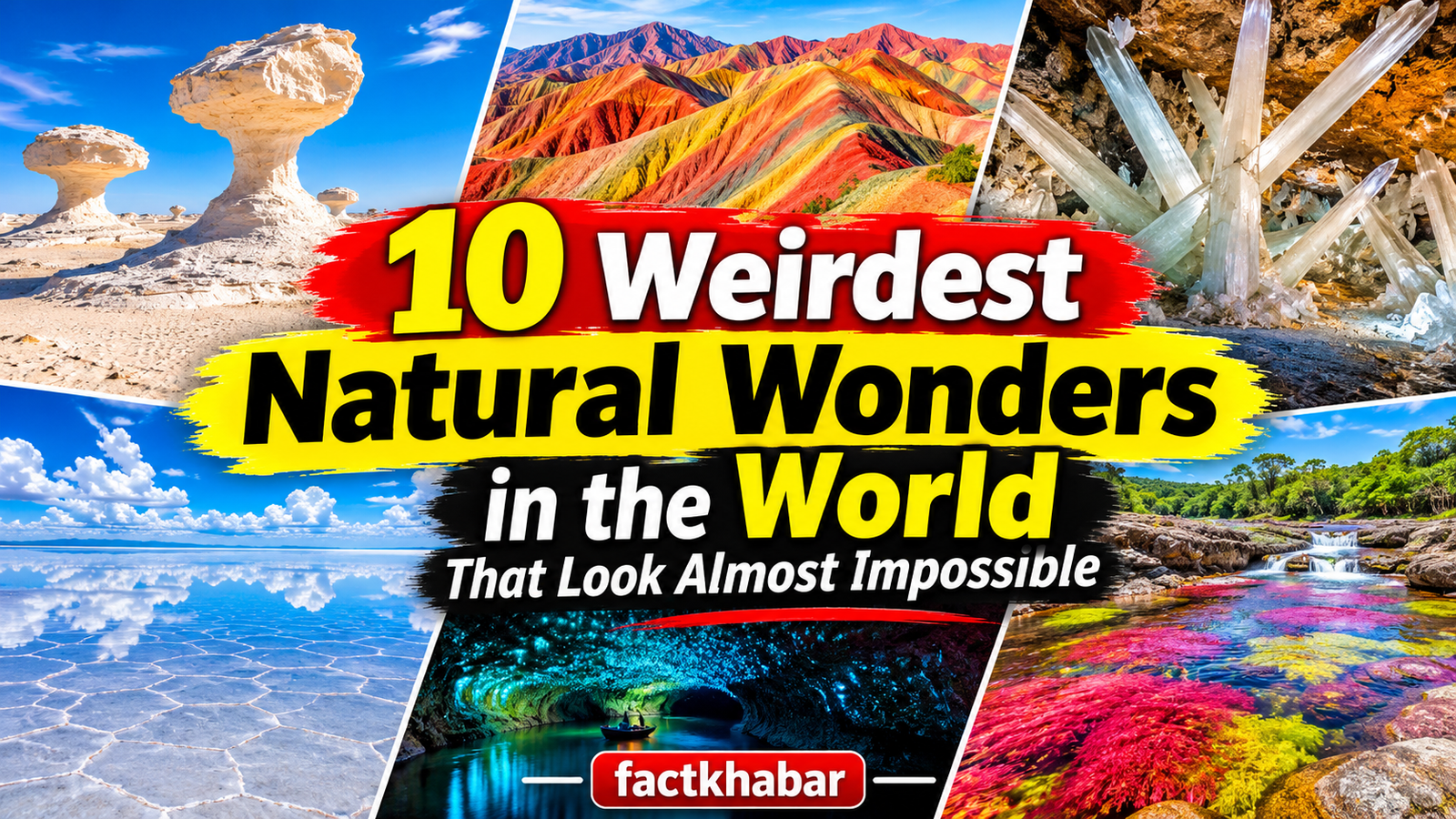
Our planet is full of extraordinary places that look as if they belong in another world. From stark white deserts and colorful mountains to glowing caves and rainbow-like rivers, nature has created truly unbelievable landscapes. What makes these places even more fascinating is that they formed naturally over thousands, or even millions, of years through geological changes, erosion, minerals, water, and unusual weather conditions. Many of these destinations are so strange that visitors often find it difficult to believe they are real. Some look like scenes from a fantasy movie, while others seem almost impossible to explain at first glance. If you enjoy discovering unusual places and learning interesting facts about Earth, here are ten of the weirdest natural wonders in the world that will leave you amazed.
1. The White Desert, Egypt
A desert that looks like a frozen landscape.
The White Desert in Egypt is one of the most unusual natural landscapes on Earth. Located in the Farafra Depression, this extraordinary desert is famous for its bright white sand and strange chalk rock formations. Unlike traditional deserts filled with golden sand, this place looks almost like a snowy landscape, making visitors feel as if they have suddenly entered a completely different part of the world. The unusual appearance of the White Desert is the result of its ancient geological history. Millions of years ago, this region was covered by water, and after the sea disappeared, layers of chalk and other mineral deposits remained behind. Over time, wind and erosion slowly shaped these deposits into unusual formations that resemble mushrooms, animals, and giant sculptures. Today, the White Desert is a protected national park and attracts visitors who want to experience one of Egypt’s most unusual natural attractions. Its peaceful surroundings, white rock formations, and unusual scenery make it one of the most fascinating deserts in the world.
2. Zhangye Danxia Landform, China
The famous Rainbow Mountains of China.
The Zhangye Danxia Landform in China is one of the most colorful natural wonders in the world. Often called the Rainbow Mountains, this extraordinary landscape features mountains covered in layers of red, orange, yellow, green, and other beautiful shades. When sunlight falls across these colorful hills, the entire landscape looks like a giant painting created by an artist. However, these colors are completely natural and were not added by humans. The unusual appearance developed over millions of years as different layers of sandstone and minerals accumulated in the region. Geological movements, weather conditions, and erosion gradually exposed these colorful layers, creating the beautiful patterns visible today. The mountains have become one of China’s most famous natural attractions and are protected as part of the Zhangye National Geopark. Visitors from different parts of the world travel here to see the unusual colors and capture photographs of this incredible landscape. It is a perfect example of how nature can create beauty without any human involvement.
3. Moeraki Boulders, New Zealand
Giant round stones scattered along a beach.
The Moeraki Boulders in New Zealand are among the strangest rock formations found along any coastline. Located on Koekohe Beach on the South Island, these enormous stones are famous for their almost perfectly round shapes. Some of them look like giant footballs, while others have unusual cracks and patterns that make them appear as if they were carefully designed. These boulders have also inspired several traditional Maori legends. According to one story, the stones are connected to the remains of food baskets and other objects from an ancient canoe called the Araiteuru. However, scientists explain that the boulders formed naturally through a geological process known as concretion. Minerals gradually accumulated around a central point within ancient seabed sediments, creating large spherical structures over millions of years. Later, erosion exposed these formations, allowing them to appear on the beach. Today, the Moeraki Boulders attract photographers, tourists, and nature lovers who want to see these mysterious-looking stones up close. Their unusual shapes make them one of New Zealand’s most recognizable natural attractions.
4. Salar de Uyuni, Bolivia
The world’s largest salt flat creates a mirror effect.
Salar de Uyuni in Bolivia is one of the most extraordinary landscapes on Earth. Covering approximately 10,582 square kilometers, it is widely recognized as the largest salt flat in the world. Thousands of years ago, this enormous area was covered by prehistoric lakes. As the water gradually evaporated, thick layers of salt and minerals remained behind, eventually creating the enormous white surface visible today. During the dry season, the salt forms beautiful geometric patterns that stretch across the landscape. However, the real magic happens during the rainy season. A thin layer of water covers the salt flat and reflects the sky so perfectly that the ground appears to disappear. The result is a breathtaking mirror-like effect that makes visitors feel as if they are walking between the sky and the Earth. Salar de Uyuni is also home to several species of flamingos that visit nearby lakes and wetlands. Apart from its natural beauty, the region is an important source of lithium, a mineral used in modern batteries. Its enormous size, unusual patterns, and incredible reflections make it one of the weirdest natural wonders in the world.
5. Cave of the Crystals, Mexico
A mysterious underground world filled with giant crystals.
Deep beneath the ground in Chihuahua, Mexico, lies one of the most unbelievable caves ever discovered. Known as the Cave of the Crystals, this extraordinary underground chamber contains some of the largest natural crystals ever found. The cave is located near the Naica mining area and became famous after giant selenite crystals were discovered inside it in 2000. Some of these crystals measure more than ten meters in length and weigh several tons. Their enormous size makes the cave look like a scene from a science fiction movie. The crystals developed over extremely long periods because of the unusual environmental conditions inside the cave. Mineral-rich water, high temperatures, and the presence of gypsum allowed the crystals to grow slowly over thousands of years. However, exploring this natural wonder is extremely dangerous because the cave experiences very high temperatures and humidity levels. These conditions make it difficult for humans to remain inside for long periods without specialized protective equipment. The Cave of the Crystals is a remarkable example of how unusual geological conditions can create natural formations that seem almost impossible.
6. Waitomo Glowworm Caves, New Zealand
A cave illuminated by thousands of glowing creatures.
The Waitomo Glowworm Caves in New Zealand offer one of the most magical natural experiences in the world. Unlike ordinary caves that remain completely dark, this underground attraction is illuminated by thousands of tiny glowing creatures attached to the cave ceilings. These creatures are known as glowworms and produce light through a natural biological process called bioluminescence. Their glowing appearance creates a beautiful effect that resembles a star-filled night sky. When visitors enter the cave, they can see countless tiny blue-green lights shining above them. The glowworms use their light to attract insects, which become trapped in thin silk threads hanging from their bodies. The cave system was formed naturally through the movement of water and the gradual erosion of limestone over long periods. Today, guided boat tours allow visitors to experience the glowing cave while helping protect the delicate environment. The combination of darkness, underground water, and thousands of glowing organisms makes Waitomo one of the most unusual natural wonders in the world.
7. Caño Cristales River, Colombia
The river that appears in five different colors.
Caño Cristales in Colombia is often called the River of Five Colors because of its extraordinary appearance. Located in the Serranía de la Macarena region, this beautiful river is famous for its bright shades of red, yellow, green, blue, and black. Unlike ordinary rivers, Caño Cristales can appear almost like a flowing rainbow during certain periods of the year. Its unusual colors are mainly produced by an aquatic plant called Macarenia clavigera. Under suitable water levels, sunlight, and seasonal conditions, this plant develops striking red and pink colors that become visible beneath the clear water. The surrounding rocks, water, and natural light create additional shades, making the river look even more colorful. The best time to experience this natural wonder is generally during the transition between the wet and dry seasons, when the conditions allow the aquatic plants to display their beautiful colors. Caño Cristales is located inside a protected natural area and attracts travelers who want to experience one of the most unusual rivers on Earth. Its incredible colors prove that even something as ordinary as flowing water can become an extraordinary natural attraction.
8. Pamukkale, Turkey
A natural landscape that looks like a white cotton castle.
Pamukkale in southwestern Turkey is another natural wonder that looks almost too beautiful to be real. Its name means Cotton Castle, and the landscape perfectly matches that description. The area is covered with white terraces, mineral formations, and naturally created pools that resemble frozen waterfalls. These unusual formations developed because of hot thermal water flowing down the hillside. The water contains dissolved calcium carbonate, which gradually deposits as the water cools and loses carbon dioxide. Over thousands of years, these deposits created the white limestone terraces that make Pamukkale famous today. The naturally warm pools have attracted visitors for centuries, and the nearby ancient city of Hierapolis became an important destination during the Roman period. Today, Pamukkale is recognized as a UNESCO World Heritage Site and is protected to preserve its unique environment. Visitors can admire the white terraces and selected pools while following conservation rules. Its unusual appearance makes it one of the most photographed natural attractions in Turkey.
9. Light Pillars
Mysterious beams of light appearing in the sky.
Light pillars are one of the strangest atmospheric phenomena that people can witness in cold regions of the world. They appear as vertical beams of light extending upward or downward from the Sun, Moon, or artificial light sources. At first glance, these glowing pillars may look like mysterious energy beams or something from a science fiction movie. However, their formation has a natural scientific explanation. Light pillars develop when light reflects off tiny, flat ice crystals suspended in the atmosphere. When these crystals are positioned in suitable horizontal orientations, they reflect light in a way that creates the appearance of vertical columns. Depending on the light source and atmospheric conditions, the pillars may appear white, yellow, red, or other shades. They have been observed in several cold locations, including Canada, Sweden, Alaska, and parts of Antarctica. Although they may sometimes be confused with the Northern Lights, light pillars are a completely different atmospheric phenomenon. Their unusual appearance and unpredictable occurrence make them one of the most fascinating natural sights in the sky.
10. Ásbyrgi Canyon, Iceland
A giant horseshoe-shaped canyon connected to ancient legends.
Ásbyrgi Canyon in Iceland is one of the most unusual geological formations in the country. Its enormous horseshoe shape makes it look as if a giant animal has pressed its footprint into the ground. Surrounded by steep cliffs and beautiful natural scenery, the canyon is a remarkable destination for people interested in unusual landscapes and geological history. According to Norse mythology, the canyon was created when Sleipnir, the eight-legged horse of the god Odin, touched the ground with one of its hooves. The story gives the location a mysterious atmosphere and has become an important part of local folklore. However, scientific explanations connect the formation of Ásbyrgi to powerful glacial floods that occurred thousands of years ago. These enormous floods carried huge amounts of water through the region, gradually shaping the landscape and creating the canyon’s unusual structure. Today, Ásbyrgi is part of Vatnajökull National Park and is known for its dramatic cliffs, green vegetation, and peaceful surroundings. It is a wonderful example of how natural forces can create landscapes that inspire both scientific explanations and ancient legends.
Conclusion
The world is filled with natural wonders that remind us how extraordinary our planet really is. From the white chalk formations of Egypt and the colorful mountains of China to the glowing caves of New Zealand and the rainbow-like river of Colombia, every destination has a unique story behind its formation. Some of these places were shaped by ancient oceans, while others developed through volcanic activity, mineral deposits, erosion, ice crystals, and unusual biological processes. What makes these natural wonders truly special is that they were not designed or constructed by humans. They are the results of natural forces working over thousands or millions of years. Exploring these unusual destinations helps us understand the incredible diversity of Earth’s landscapes and the importance of protecting them for future generations. Which of these weirdest natural wonders would you love to visit first?