
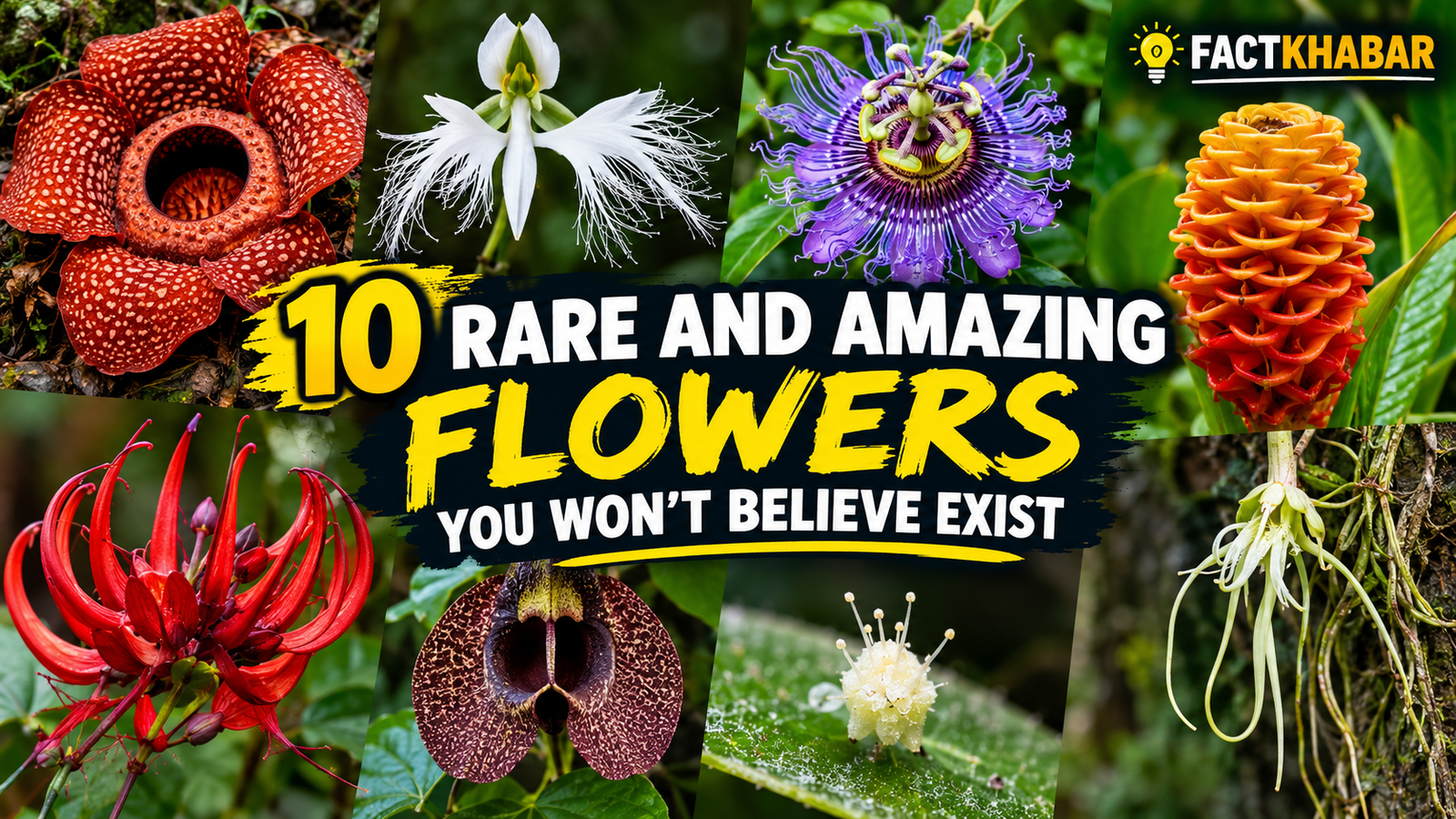
10 Rare and Amazing Flowers You Won’t Believe Exist. Flowers are among the most beautiful creations of nature, but not every flower looks like a traditional rose, sunflower, or lily. Around the world, there are extraordinary flowers with unusual shapes, surprising colours, strange fragrances, and fascinating survival techniques. Some resemble animals, while others look like creatures from science fiction movies. A few grow underground, and some depend entirely on other plants for their survival. These unusual flowers demonstrate how creative and unpredictable nature can be. In this article, we will explore 10 rare and amazing flowers you won’t believe exist, including their unique characteristics, natural habitats, and the fascinating secrets that make them different from ordinary flowers.
1. Hydnora africana: The Strange Flower That Grows Underground
Hydnora africana is one of the strangest flowering plants found in southern Africa. Unlike most plants, which produce green leaves and grow above the ground, this unusual species spends most of its life hidden beneath the soil. Only its fleshy flower emerges above the surface, and its unusual appearance can make it look like a strange creature with teeth. Hydnora africana is a parasitic plant that lacks chlorophyll, meaning it cannot produce its own food through photosynthesis. Instead, it obtains nutrients by attaching itself to the roots of host plants. One of its most remarkable characteristics is its unpleasant smell, which resembles rotting organic matter. This odour attracts carrion beetles and dung beetles, which enter the flower and help transfer pollen. The flower temporarily traps some of these insects before releasing them, allowing pollination to take place. After successful pollination, the plant produces an underground fruit containing numerous seeds. Hydnora africana is a remarkable example of how plants can develop unusual strategies to survive and reproduce in challenging environments.
2. Snake Gourd Flower: A Beautiful Bloom with a Strange Fruit
The snake gourd plant is well known for its delicate white flowers and unusually long fruits. Native to parts of Asia, including India, this climbing plant produces flowers with thin, lace-like extensions around their petals. These delicate structures create an intricate appearance that makes the flower look almost like a piece of handmade lace. The flowers generally open at night, giving them a particularly attractive appearance in the evening. However, the plant’s fruit looks very different from its beautiful bloom. Snake gourd fruits can grow several feet long and often twist or curl as they develop, giving them a snake-like appearance. This striking contrast between the flower and the fruit makes the plant especially interesting to gardeners and nature enthusiasts. Snake gourd is also cultivated as a vegetable in several Asian countries, where its young fruits are used in traditional dishes. Its combination of ornamental beauty and practical value makes it an excellent example of the many ways flowering plants contribute to both nature and human life.
3. White Egret Flower: An Orchid That Looks Like a Flying Bird
The white egret flower, scientifically known as Pecteilis radiata, is a beautiful orchid native to East Asia, particularly Japan, Korea, and parts of China. Its name comes from the flower’s remarkable resemblance to a white egret spreading its wings while flying. The delicate white petals form a bird-like shape, while the flower’s broad, fringed lip gives it an especially graceful appearance. This orchid is admired by plant lovers because its natural structure looks almost like a tiny bird made entirely of petals. Despite its beauty, the white egret flower can be vulnerable to habitat destruction and excessive collection. The conversion of natural grasslands and wetlands into agricultural or developed land can reduce the places where it grows. Collecting wild orchids can also put additional pressure on vulnerable populations. Protecting its natural habitat is therefore important for the long-term survival of this remarkable plant. The white egret flower reminds us that some of the most extraordinary designs in nature do not need human imagination or artistic skill; they develop naturally through the process of evolution.
4. Yutan Puluo: The Tiny Flower Surrounded by Mystery
Yutan Puluo, also written as Udumbara in some cultural traditions, is associated with fascinating stories and legends in parts of Asia. It is often described in popular accounts as an extremely tiny flower that may appear on unusual surfaces, including leaves, metal objects, or religious statues. Some traditional beliefs associate its appearance with spiritual events, good fortune, or the arrival of an extraordinary ruler. These stories have made the flower a subject of curiosity among people interested in culture, mythology, and natural mysteries. However, claims about its exceptional rarity and supernatural significance should be understood as cultural traditions rather than established scientific facts. Tiny biological growths found on different surfaces can sometimes be difficult to identify without careful examination. For this reason, the appearance of a small white structure should not automatically be considered proof of a rare flowering plant. Nevertheless, the stories surrounding Yutan Puluo demonstrate how nature can inspire imagination and become closely connected with religious beliefs and cultural traditions. Its place in Asian folklore makes it an interesting subject for anyone who enjoys exploring the relationship between the natural world and human history.
5. Ghost Orchid: The Mysterious Flower That Appears to Float
The ghost orchid, scientifically known as Dendrophylax lindenii, is one of the most fascinating orchids found in the Americas. It is native to parts of Florida, Cuba, and the Bahamas, where it grows in humid forests and swampy environments. Unlike many familiar flowering plants, the ghost orchid has no ordinary leaves. Instead, its green roots attach to tree surfaces and carry out photosynthesis, allowing the plant to produce energy. Its delicate white flowers emerge from the root system and can appear to float in the air, especially when viewed against a dark background. This unusual appearance explains why the plant is known as the ghost orchid. The species is also famous for being difficult to cultivate because it depends on specific environmental conditions, including suitable humidity, temperature, and relationships with fungi and pollinators. Its flowers are adapted for pollination by specialised moths with long feeding structures. Habitat loss, illegal collection, and environmental changes have contributed to concerns about its survival. Protecting the wetlands and forests where it grows is essential for preserving this extraordinary orchid for future generations.
6. Corpse Lily: The Giant Flower with a Powerful Smell
The corpse lily is a common name associated with Rafflesia arnoldii, a remarkable flowering plant native to the tropical forests of Indonesia. It is famous for producing one of the largest individual flowers in the world, with some blooms reaching approximately three feet or more in diameter. Its enormous reddish petals are covered with pale spots, creating an appearance that is very different from most familiar flowers. However, its size is not the only unusual feature. The corpse lily produces a strong smell resembling decaying flesh, which attracts insects that help with pollination. Despite its impressive flower, the plant does not have ordinary leaves, stems, or roots. It lives as a parasite inside the tissues of host vines and depends on them for water and nutrients. Much of its life remains hidden from view, and the visible flower lasts for only a short period before beginning to decay. Because the plant depends on specific host species and tropical forest conditions, habitat destruction can threaten its survival. The corpse lily demonstrates that a flower does not need a pleasant fragrance or delicate appearance to play an important role in its ecosystem.
7. Devil’s Hand Tree: A Flower That Resembles a Strange Hand
The devil’s hand tree, scientifically known as Chiranthodendron pentadactylon, is native to parts of southern Mexico and Guatemala. Its flowers are among the most unusual in the plant world because their long, curved stamens resemble the fingers of an open hand. The deep red colour and distinctive shape make the blooms look dramatic and slightly mysterious. This unusual structure has helped the tree become famous among botanical enthusiasts and people interested in rare plants. The tree can grow to a considerable height under suitable conditions, and its distinctive flowers stand out against its green foliage. Historically, some Indigenous communities in Mexico and Central America have used parts of the plant in traditional practices, including remedies associated with discomfort and heart-related complaints. Such historical uses are not the same as proof of medical effectiveness, and the plant should not be used as a treatment without reliable medical guidance. Beyond its cultural significance, the devil’s hand tree is an important reminder of the incredible variety of flower shapes found across the world. Its unusual appearance makes it a striking example of how natural forms can inspire both curiosity and traditional storytelling.
8. Aristolochia salvadorensis: The Flower That Looks Like a Mask
Aristolochia salvadorensis is a distinctive flowering plant associated with Central America, particularly El Salvador and Guatemala. Its unusual blooms have a dramatic shape that many people compare to a mask or a fictional character’s face. The flower’s dark colouring and unusual openings make it look unlike the flowers commonly found in gardens. Like several other plants in the genus Aristolochia, it uses a specialised pollination strategy that involves attracting insects with distinctive odours. In some species, insects enter the flower and encounter internal structures that temporarily delay their escape. During this process, pollen can be transferred between flowers, helping the plant reproduce. The unusual shape is not simply decorative; it is connected to the plant’s biological function. The comparison with a science-fiction character may make the flower entertaining to look at, but its true importance lies in its adaptation to its environment. Plants such as Aristolochia salvadorensis show that flowers can develop remarkable shapes and structures as part of their reproductive strategies. For nature enthusiasts, discovering such species is a reminder that even familiar plant groups can contain surprising and extraordinary members.
9. Beehive Ginger: A Flower That Looks Like a Beehive
Beehive ginger, scientifically known as Zingiber spectabile, is a tropical plant native to Southeast Asia. It gets its common name from its unusual flower structure, which resembles a small beehive. The plant produces compact clusters of overlapping bracts that may appear yellow, green, orange, or reddish as they mature. These structures give the plant a bold appearance that makes it popular in tropical gardens and botanical collections. Its actual flowers are smaller and often emerge from the spaces between the colourful bracts. Beehive ginger belongs to the ginger family, which includes several plants valued for their ornamental or culinary uses. However, this species is particularly admired for its distinctive appearance rather than for use as a common cooking ingredient. The plant grows well in warm, humid environments and generally prefers suitable moisture and partial shade. Its unusual form shows how flowering plants can develop structures that look very different from the traditional image of a flower with separate, colourful petals. Beehive ginger is a wonderful example of nature’s creativity and is especially interesting to people who enjoy discovering exotic tropical plants.
10. Purple Passionflower: A Flower Full of Intricate Details
The purple passionflower, scientifically known as Passiflora incarnata, is a striking climbing plant native to parts of North America. Its flowers have an intricate arrangement of petals, colourful filaments, and reproductive structures that make them look almost like miniature works of art. The unusual appearance of passionflowers has inspired many cultural interpretations throughout history. During the seventeenth century, some Christian observers associated parts of the flower with elements of the story of the crucifixion of Jesus Christ. The flower’s name reflects these historical religious associations. Apart from its symbolic significance, the purple passionflower plays an important role in the natural environment. Its blooms attract pollinators, while its foliage provides food for the caterpillars of certain butterfly species. As a climbing plant, it uses tendrils to attach itself to nearby supports and can spread across fences, shrubs, and garden structures. The species has also been studied for compounds that may have calming effects, although medicinal use requires appropriate evidence and professional advice. Its intricate appearance, ecological value, and cultural history make the purple passionflower one of the most fascinating flowers to explore.
Why Are Some Flowers So Unusual?
Flowers develop different shapes, colours, and fragrances because these characteristics can help plants survive and reproduce in their particular environments. Some flowers produce strong smells to attract insects that feed on decaying organic matter, while others use bright colours or elaborate structures to attract specific pollinators. Parasitic flowering plants have developed alternative ways to obtain nutrients, allowing them to survive without producing all their own food through photosynthesis. Other species have evolved specialised relationships with insects, birds, or mammals that help carry pollen from one flower to another. Environmental conditions, including temperature, rainfall, soil quality, and the availability of pollinators, can also influence how plants grow and reproduce. Over many generations, these biological processes have produced the extraordinary diversity of flowers found around the world. What may look strange or frightening to humans often serves a practical purpose in nature, helping a plant attract pollinators, conserve resources, or reproduce successfully.
How Can We Help Protect Rare Flowers?
Protecting rare flowers begins with conserving the natural habitats where they grow. Forest clearing, wetland destruction, pollution, climate change, and illegal collection can all put pressure on vulnerable plant species. People can help by avoiding the purchase of illegally collected wild plants, supporting responsible botanical gardens, and learning about native flowering species. Gardeners should choose suitable cultivated plants rather than removing rare flowers from their natural environments. Supporting habitat restoration and responsible conservation programmes can also help preserve the insects, fungi, and other organisms that some unusual plants depend on. Education is equally important because people are more likely to protect species when they understand their ecological importance. Even flowers that appear unattractive or unusual can play valuable roles in their ecosystems. By respecting the natural world and reducing damage to sensitive habitats, we can help ensure that future generations have the opportunity to discover these extraordinary plants.
Conclusion
The world of flowers is far more diverse than many people realise. From the underground-growing Hydnora africana and the bird-like white egret flower to the enormous corpse lily and the mysterious ghost orchid, each plant has unique characteristics that make it fascinating. Some depend on other plants for nutrients, while others use unusual fragrances and specialised structures to attract pollinators. The beehive ginger and purple passionflower demonstrate that even familiar plant groups can produce extraordinary forms. These 10 rare and amazing flowers remind us that nature is full of surprises and that beauty comes in many different forms. Learning about unusual flowers is not only entertaining but also helps us appreciate the importance of biodiversity and habitat conservation. The more we discover about the natural world, the more reasons we find to protect it.
Frequently Asked Questions (FAQs)
What is the rarest flower in the world?
There is no single universally accepted answer because rarity can be measured in different ways, including the number of surviving plants, geographic distribution, and difficulty of cultivation. Several orchids and other specialised flowering plants are considered rare or threatened.
Which flower has the largest individual bloom?
Rafflesia arnoldii is widely known for producing one of the largest individual flowers in the world. Its bloom can reach around three feet or more in diameter under suitable conditions.
Which flower smells like rotting flesh?
Several flowers produce odours resembling decaying flesh to attract insect pollinators. These include Rafflesia arnoldii and Hydnora africana, although their biology and appearance are different.
Why does the ghost orchid look as if it is floating?
The ghost orchid has no ordinary leaves, and its delicate white flowers emerge from a system of exposed green roots. Against a dark forest background, the blooms can appear to float in the air.
Why should we protect rare flowers?
Rare flowers contribute to biodiversity and may support specialised pollinators and other organisms. Protecting them also helps preserve natural habitats, ecological relationships, and the extraordinary diversity of plant life on Earth.