
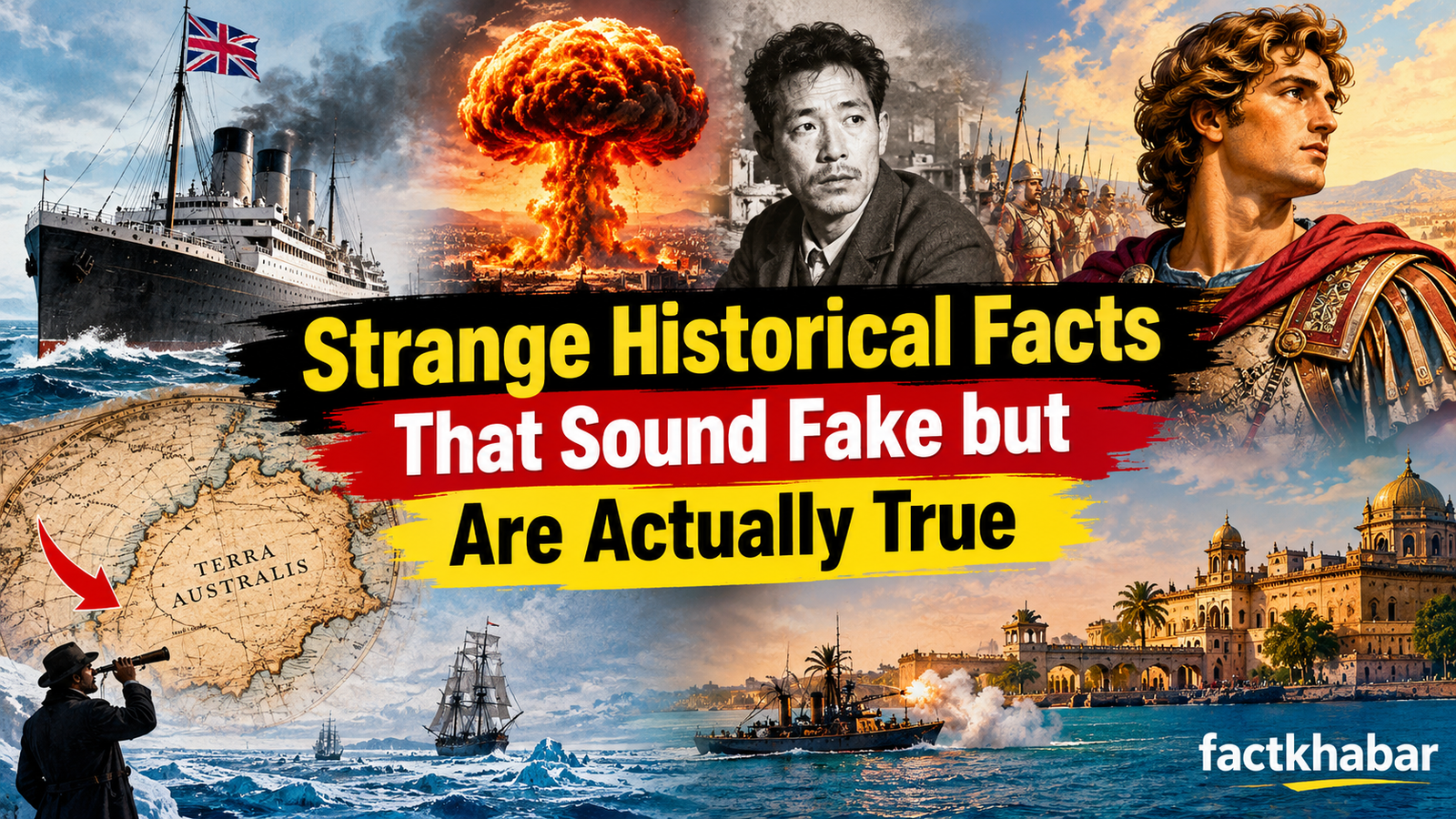
Strange Historical Facts: History is full of surprising events that seem almost impossible to believe. From unusual wartime strategies to people who survived unimaginable disasters, the past is filled with stories that sound like something out of a movie. However, many of these events really happened and have become fascinating parts of history. Some involve powerful empires, famous leaders, and major wars, while others reveal how much we still have to learn about the people and places that shaped our world.
In this article, we will explore some strange historical facts that sound fake but are actually true. These stories show that history is not just about dates, battles, and important people. It is also full of unexpected twists, remarkable coincidences, and extraordinary events that make the past much more interesting than we might imagine.
1. A German Ship Disguised Itself as a British Warship
During the First World War, countries searched for creative ways to gain an advantage over their enemies. One remarkable example involved the German auxiliary cruiser SMS Cap Trafalgar and the British passenger liner RMS Carmania. Both ships were converted for wartime use, showing how ordinary passenger vessels could become part of a naval conflict.
In September 1914, the German ship encountered the British Carmania near the Brazilian coast. The two vessels fought a fierce naval battle, and the Carmania eventually sank the German ship. Although the details of wartime deception are sometimes simplified in popular accounts, the real battle demonstrates how passenger ships could be transformed into armed vessels during wartime. It is an unusual chapter of naval history that many people would find difficult to believe without knowing the background.
2. One Man Survived Both Atomic Bombings in Japan
One of the most astonishing stories from the Second World War is that of Tsutomu Yamaguchi, a Japanese engineer who survived both atomic bombings. In August 1945, he was working in Hiroshima when the United States dropped the first atomic bomb on the city. He suffered serious injuries but survived the devastating explosion.
After receiving initial treatment, Yamaguchi returned to his hometown of Nagasaki. Just three days later, on August 9, the second atomic bomb was dropped on Nagasaki. Despite being exposed to another catastrophic event, he survived again. His experience is a powerful reminder of the human suffering caused by nuclear weapons. The Japanese government later officially recognized him as a survivor of both bombings. His story remains one of the most extraordinary examples of survival in modern history.
3. Alexander the Great Never Lost a Major Battle
Alexander the Great is remembered as one of the most successful military commanders in ancient history. He became king of Macedonia in 336 BC after the assassination of his father, Philip II. Alexander was only about 20 years old when he took the throne, yet he soon began an ambitious campaign to expand his empire.
His military campaigns took him through the Persian Empire, Egypt, and parts of Central and South Asia. During his conquests, he defeated several powerful armies and established control over enormous territories. Historians generally recognize that Alexander never lost a major battle during his military career, although his campaigns involved significant challenges and losses. Alexander died in Babylon in 323 BC at approximately 32 years of age. The exact cause of his death remains uncertain. Some theories suggest illness or infection, while other explanations have also been proposed. His remarkable military record and mysterious death continue to attract the attention of historians and readers around the world.
4. The Anglo-Zanzibar War Lasted Less Than an Hour
Wars are often associated with years of fighting, massive armies, and enormous destruction. However, the Anglo-Zanzibar War of August 27, 1896, was exceptionally short. It is widely considered the shortest recorded war in history, lasting approximately 38 to 45 minutes, depending on the source and how its duration is measured. The conflict began after a dispute over the succession to the throne of Zanzibar, an island territory off the eastern coast of Africa. The British government supported one candidate for the position of sultan, while Khalid bin Barghash seized the palace and claimed the throne without British approval.
British forces demanded that Khalid surrender his position. When he refused, British warships opened fire on the palace. The bombardment quickly overwhelmed the defenders, and Khalid eventually fled to the German consulate for refuge. The conflict ended within minutes, but the consequences were serious. Hundreds of people were killed or injured, mainly among the defenders and people caught in the bombardment. This unusual historical event demonstrates how dramatically the balance of military power can influence the outcome of a conflict.
5. People Mapped Antarctica Before Exploring It Fully
It may seem strange that early mapmakers sometimes drew land that had not yet been properly explored. However, this happened with Antarctica. For centuries, European scholars believed that a large southern landmass must exist to balance the continents of the Northern Hemisphere. Ancient geographical ideas influenced maps created long before Antarctica was confirmed to exist as a continent. During the Renaissance, some maps included a hypothetical southern region called Terra Australis, a Latin expression meaning “southern land.” These drawings were based on geographical theories rather than accurate observations of the Antarctic mainland.
In January 1820, Russian explorers associated with Fabian Gottlieb von Bellingshausen’s expedition reported sighting Antarctic ice. Other expeditions also approached or sighted the continent around the same period, and the history of its discovery involves several competing accounts. The surprising part is that people imagined a vast southern land long before they had reliable information about its geography. Although early maps were not accurate representations of Antarctica, they show how curiosity and scientific theories influenced the way people understood the world.
Why These Strange Historical Facts Matter
These unusual stories reveal that history is far more complex and surprising than a simple list of dates and events. A ship could become a weapon of war, one person could survive two atomic bombings, and a major international conflict could end in less than an hour. Meanwhile, ancient military campaigns and early geographical theories continue to raise interesting questions about human ambition, courage, and curiosity.
Learning strange historical facts also helps us understand the circumstances in which people lived. Wartime decisions, political rivalries, scientific discoveries, and personal experiences all played important roles in shaping the past. When we explore these events carefully, we gain a clearer understanding of the people behind the history books.
Conclusion
The world is full of strange historical facts that sound fake but are actually true. From the naval battle involving the Carmania to Tsutomu Yamaguchi’s survival of both atomic bombings, these events demonstrate how extraordinary real life can be. Alexander the Great’s military achievements, the remarkably short Anglo-Zanzibar War, and the early maps depicting a hypothetical southern continent provide further examples of history’s unexpected side.
The most interesting thing about history is that many incredible stories do not need to be invented. They already happened, and the truth is often surprising enough on its own. By exploring these events, we can make learning history more enjoyable while discovering new perspectives on the past.