
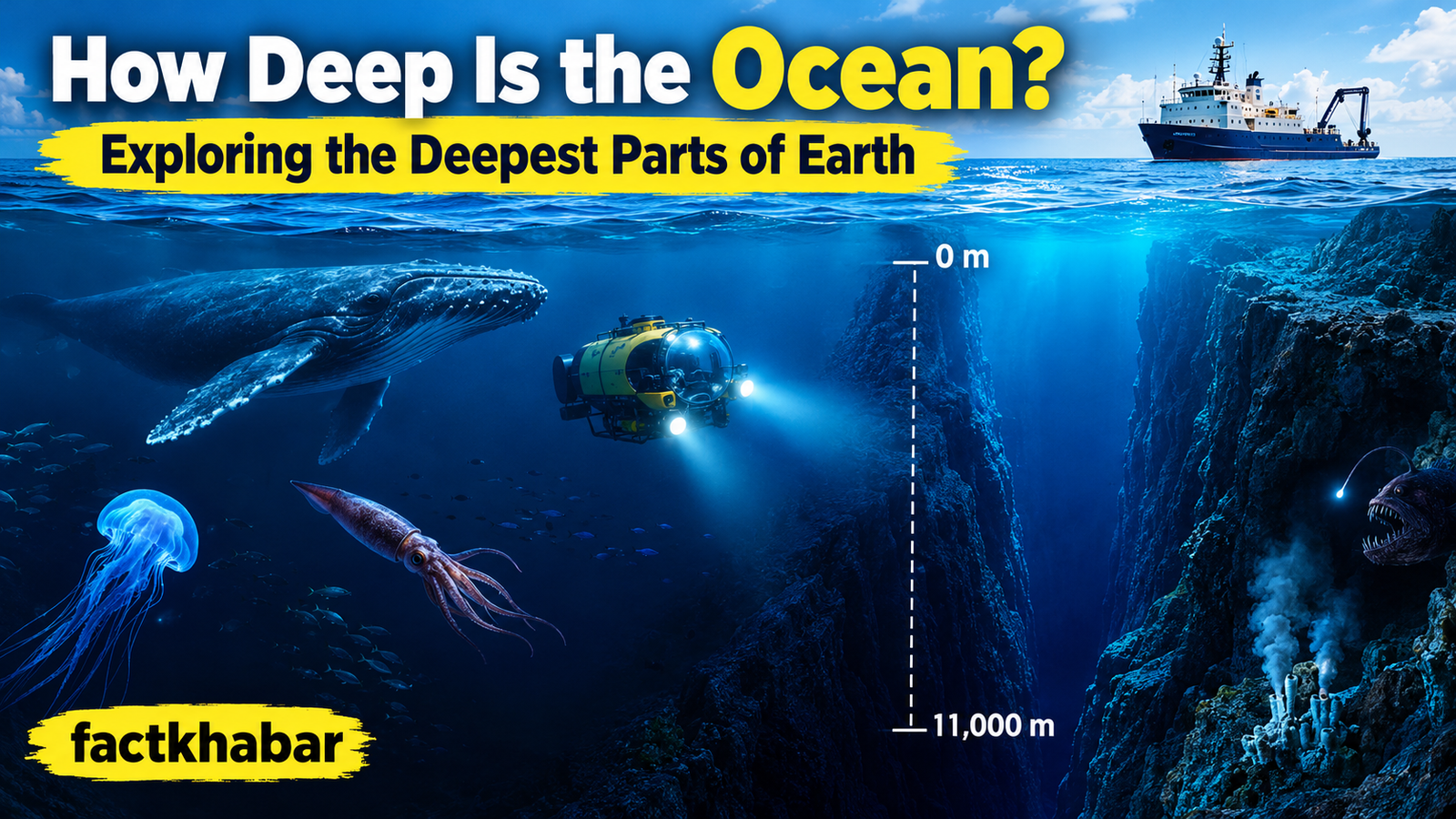
How Deep Is the Ocean? About 75% of Earth is covered by water, while the remaining 25% is land. Around 94% of life is aquatic, and the remaining 6% lives on land. Humans have not yet fully explored all the land on Earth, and many places remain untouched by humans. Similarly, humans have explored only 5% of the ocean. This raises an interesting question: how deep is the ocean, and why have humans explored so little of it? The ocean holds many secrets, including mysterious creatures, unexplored areas, and the deepest places on Earth.
Why Have Humans Explored So Little of the Ocean?
The ocean is one of the most mysterious places on our planet. Although scientists have developed advanced technology, exploring the deepest parts of the ocean remains extremely difficult. One major reason is the enormous water pressure that increases with depth. As humans travel deeper into the ocean, the pressure becomes more dangerous for the human body and underwater equipment. Another reason is the lack of sunlight. As the depth increases, sunlight gradually disappears, making it difficult to see and explore the surroundings. The deep ocean is also extremely cold, which creates additional challenges for researchers and exploration vehicles.
Why Can Scuba Divers Dive Only to Certain Depths?
Scuba diving allows humans to explore underwater environments, but recreational divers generally have a maximum depth limit of around 40 meters. This limit exists because diving deeper increases the risks associated with water pressure and breathing compressed gas. At a depth of 100 meters, the surrounding pressure is approximately 11 times the atmospheric pressure at sea level. This pressure can affect air-filled spaces in the human body, including the lungs and sinuses. Divers must learn proper breathing techniques and pressure-equalization methods to reduce the risks associated with diving. One serious condition related to pressure changes is called barotrauma. It occurs when pressure differences damage air-filled spaces in the body. Ear barotrauma can damage the eardrum, sinus barotrauma can cause pain and swelling, and lung barotrauma can damage lung tissue. These injuries can be life-threatening in severe cases.
Herbert Nitsch and the Deepest Free Dive
Although recreational scuba diving has depth limits, some experienced divers have reached much greater depths using specialized techniques. Herbert Nitsch is an Austrian freediver known for his achievements in deep diving. In 2012, he attempted a No Limits freediving dive to a depth of 253.2 meters. The dive caused serious health complications, and he required an extended recovery period. His achievement demonstrates the extreme risks involved in deep human diving.
What Happens at a Depth of 500 Meters?
At a depth of 500 meters, the ocean becomes much darker, and the water pressure reaches approximately 51 times the atmospheric pressure at sea level. Sunlight is extremely limited at this depth, and ordinary human diving equipment cannot safely take divers there. This depth lies within the mesopelagic zone, also known as the twilight zone. Many marine animals live in this region, where light is too weak to support photosynthesis. The pressure at this depth also creates significant challenges for underwater vehicles. Submarines and submersibles must be specially designed to withstand the enormous forces exerted by the surrounding water.
The Ocean’s Different Depth Zones
The ocean is divided into several zones according to depth and the amount of sunlight that reaches them.
1. The Photic Zone
The photic zone extends from the ocean surface to approximately 200 meters. Sunlight reaches this region, allowing photosynthesis to occur. As a result, this zone supports a large amount of marine life and provides suitable conditions for many ocean ecosystems.
2. The Twilight Zone
The twilight zone generally extends from about 200 meters to 1,000 meters. Sunlight becomes increasingly weak as depth increases, and photosynthesis is no longer possible in most of this region. Many marine animals have adapted to the low-light conditions found here.
3. The Aphotic Zone
The aphotic zone lies below approximately 1,000 meters, where sunlight does not reach in sufficient quantities to support photosynthesis. This region is dark and cold, and the water pressure is extremely high. Many deep-sea creatures survive here through special adaptations that help them live in such challenging conditions.
How Much Pressure Exists at 550 Meters?
As a person travels deeper into the ocean, water pressure increases significantly. At a depth of approximately 550 meters, the pressure is around 56 times the atmospheric pressure at sea level. Such extreme pressure makes human exploration difficult without specialized equipment. Deep-sea animals, however, have adaptations that allow them to survive in environments where humans cannot live without protection.
What Is Found at a Depth of 830 Meters?
At approximately 830 meters, the ocean is completely dark, and the water pressure is roughly 84 times the atmospheric pressure at sea level. This depth is much deeper than the height of many familiar buildings, including the Burj Khalifa, which stands approximately 830 meters tall. The deep ocean contains fascinating animals, including giant squid and other species adapted to dark environments. These creatures survive under conditions that would be extremely dangerous for humans.
Leatherback Sea Turtles and Deep Diving
Leatherback sea turtles are among the largest living turtle species. They can grow to more than two meters in length, and exceptionally large individuals can weigh hundreds of kilograms. These turtles are remarkable divers and can travel to considerable depths while searching for food. Their bodies have adaptations that allow them to tolerate the pressure changes associated with diving. However, their diving abilities and the depths they reach vary depending on individual animals and environmental conditions.
Sperm Whales and Colossal Squid
Sperm whales are deep-diving marine mammals known for their ability to hunt squid in the ocean’s darker regions. Colossal squid are also among the largest invertebrates on Earth and live in deep Antarctic waters. These animals are often discussed together because squid remains and sucker marks have been found on sperm whales, providing evidence of encounters between the two species. Their interactions are part of the complex relationships found in deep-sea ecosystems. Colossal squid can grow to impressive sizes, although their exact maximum dimensions and weight are difficult to establish because complete specimens are rarely observed.
Where Is the Titanic Wreck Located?
The wreck of the Titanic lies at a depth of approximately 3,800 meters in the North Atlantic Ocean. At this depth, the pressure is roughly 380 times the atmospheric pressure at sea level. The wreck is an important site for underwater exploration and research. Its location demonstrates the difficulties involved in exploring deep ocean environments, where specialized submersibles and carefully planned missions are necessary.
The Abyssal Zone: Around 4,000 Meters Deep
The abyssal zone generally extends from approximately 4,000 meters to 6,000 meters. It is characterized by complete darkness, low temperatures, and enormous water pressure. At a depth of 4,000 meters, the pressure is approximately 400 times the atmospheric pressure at sea level. Despite these harsh conditions, marine life survives in this environment. Deep-sea fish, crustaceans, and other organisms have adapted to the darkness and pressure. Their existence shows how life can survive in environments that once seemed impossible to explore.
The Hadal Zone: The Deepest Ocean Region
The hadal zone refers to the deepest parts of the ocean, particularly deep-sea trenches found below approximately 6,000 meters. Its name comes from Hades, the ancient Greek underworld. At a depth of 6,000 meters, the pressure reaches roughly 600 times the atmospheric pressure at sea level. The environment is extremely challenging, but some organisms have adapted to survive in these deep trenches. Scientists continue to investigate these areas to understand the creatures living there and the conditions that make life possible at such extreme depths.
How Do Scientists Explore the Deep Ocean?
Although humans have explored only a small portion of the ocean directly, scientists can learn about deep-sea environments through specialized submersibles, underwater cameras, sonar systems, and research missions. Deep-diving vehicles can carry instruments and cameras into regions that are too dangerous for human divers. These technologies help researchers study underwater landscapes, locate shipwrecks, and observe marine animals. Research submersibles have played an important role in increasing our understanding of the ocean. They allow scientists to collect information about depth, pressure, temperature, and marine life without exposing people directly to the surrounding conditions.
The Deepest Known Parts of the Ocean
As scientists travel deeper into the ocean, they encounter regions that are far below the depths reached by ordinary diving equipment. At approximately 8,840 meters, the depth is comparable to the height of Mount Everest measured from sea level. The Mariana Trench contains the deepest known parts of the ocean. Its deepest region, Challenger Deep, reaches approximately 10,900 to 11,000 meters, although measurements vary. At these depths, the pressure is more than 1,000 times the atmospheric pressure at sea level. Only specially engineered deep-diving vehicles can reach such extreme environments.
Victor Vescovo and the Mariana Trench
Victor Vescovo is an American investor and deep-sea explorer who led the Five Deeps Expedition. In 2019, he reached a depth of approximately 10,984 meters in the Mariana Trench using a specialized submersible called Limiting Factor. His expedition demonstrated that humans can reach the deepest known parts of the ocean and return safely with the help of advanced engineering and careful planning. Explorations like this have helped scientists gather valuable information about deep-sea environments and improve our understanding of the ocean’s most extreme regions.
What Secrets Are Still Hidden in the Ocean?
The ocean remains one of Earth’s least explored environments. Scientists continue to discover new marine species, investigate underwater landscapes, and study ecosystems that survive under extreme conditions. There may be many organisms that humans have not yet discovered. However, claims about hidden civilizations or extraterrestrial life beneath the ocean remain speculation rather than established scientific facts. Future advances in technology may allow researchers to explore more of the ocean and answer questions that remain unresolved today.
Conclusion
The ocean is an enormous and mysterious part of our planet. From the sunlight-filled surface waters to the dark depths of the Mariana Trench, each region contains different environmental conditions and forms of marine life. Extreme pressure, cold temperatures, and limited visibility make deep-sea exploration difficult, but specialized submersibles and scientific research continue to reveal more about this underwater world. Although humans have made significant progress in exploring the ocean, much remains unknown. Future discoveries may help us understand deep-sea creatures, underwater ecosystems, and the hidden landscapes of Earth’s deepest regions.