
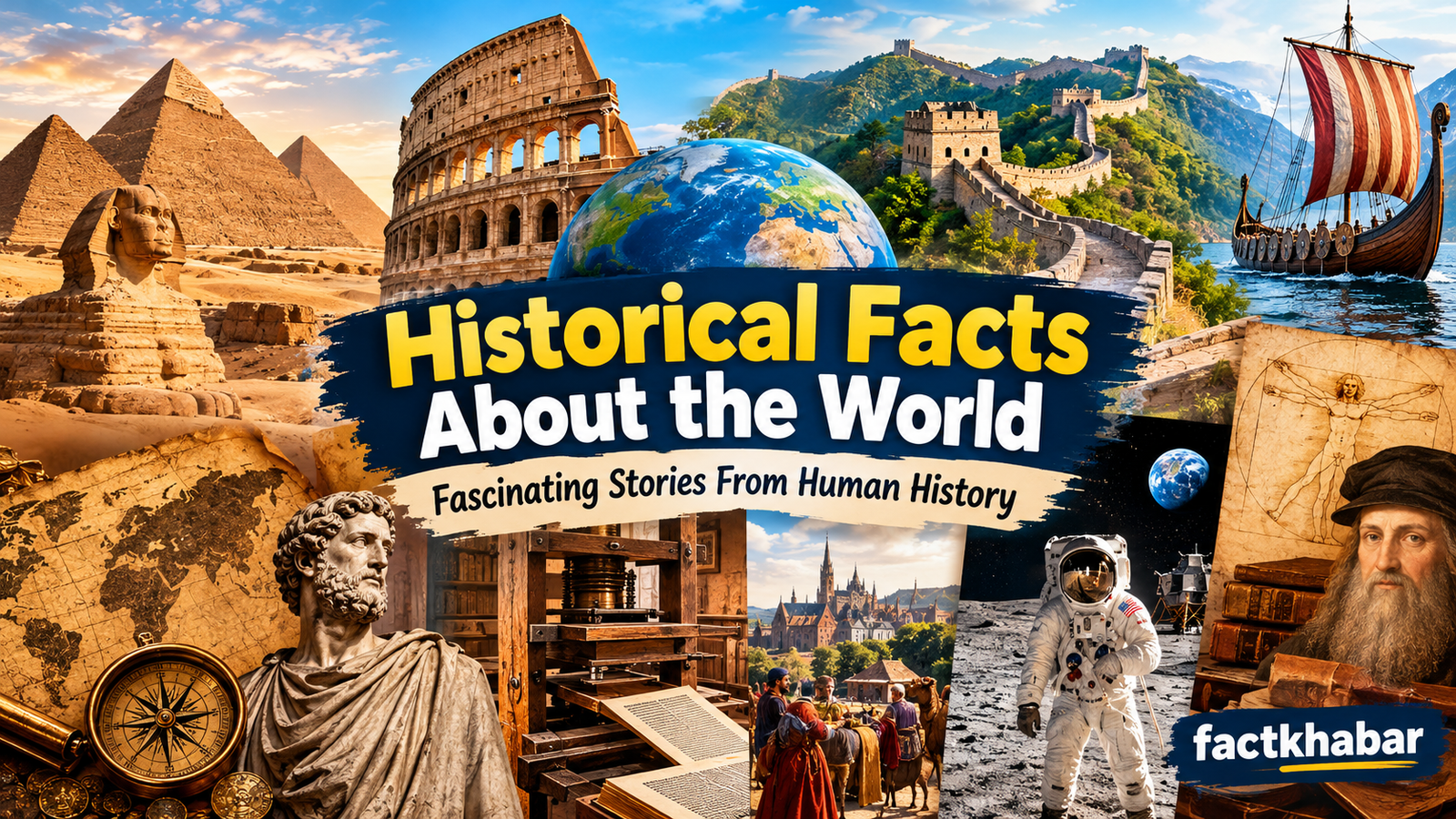
Historical Facts About the World: History is full of fascinating stories, remarkable achievements, influential civilizations, and major events that have shaped the modern world. When we examine historical facts about the world, we see how people lived, how societies developed, how countries grew, and how inventions and discoveries affected daily life. Some of the past’s events are well-known, while others are surprisingly less familiar. World history gives us a fascinating insight into how humanity came to where it is today, from ancient civilizations and huge empires to scientific discoveries and historic achievements.
Surprisingly, ancient civilizations were advanced
Many ancient civilizations were much more advanced than people often realize. Thousands of years ago, people developed organized governments, systems of writing, knowledge of mathematics, methods of farming, networks of trade, and impressive forms of architecture. Ancient Egypt is a very good example. Egyptian civilization was built along the Nile River and was known for its pyramids, temples, writing system, and knowledge of agriculture. The Great Pyramid of Giza remains one of the most impressive ancient structures. Constructing it required great planning, organization, engineering skills, and human labor, which shows that ancient societies had knowledge that still astounds historians to this day.
Mesopotamia and the Birth of Writing
Mesopotamia is frequently mentioned as one of the earliest centers of civilization. The region, which is mainly between the Tigris and Euphrates rivers, was home to several important ancient societies. In Mesopotamia, people created cities, governments, agricultural systems, trade routes, and one of the first known systems of writing, cuneiform. They wrote on clay tablets, using pressed symbols to record everything from business transactions to laws to stories. A famous example is the Code of Hammurabi, a set of laws developed under the Babylonian ruler Hammurabi. These first written records provide important information to historians about how people lived and organized their societies thousands of years ago.
The Great Wall of China Took Centuries to Build
The Great Wall of China is one of the most famous structures in world history, but it wasn’t one wall at one particular time. Defensive walls were built by various Chinese states at different times, and many of these segments were later repaired, extended, or joined together by later rulers. The best-known surviving parts were largely built or reinforced in the Ming Dynasty. Walls were constructed to defend territories, control important routes, and shield communities from raids and invasions. Now, the Great Wall is a symbol of Chinese history for centuries and is one of the most famous monuments in the world.
The Roman Empire has had an effect on the world today.
Ancient Rome was one of the most powerful civilizations in history and eventually ruled much of Europe, North Africa, and parts of the Middle East. The Romans were famous for their military organization, roads, bridges, aqueducts, architecture, and legal traditions. Their road network linked far-flung regions of the empire and helped soldiers, traders, and officials get around more easily. Roman engineering was also quite advanced for the day, with aqueducts bringing water for long distances. Ideas about Roman law, government, architecture, and infrastructure continued to influence later societies long after the Roman Empire fell.
Vikings Were Traders and Explorers
Vikings are often considered warriors, but their story is much more than battles and raids. They were also farmers, merchants, sailors, and explorers who traveled over large parts of Europe and the North Atlantic. One of the most interesting historical facts about the world is that Norse explorers visited North America centuries before Christopher Columbus’s famous 1492 voyage. Archeological evidence at L’Anse aux Meadows in Newfoundland, Canada, supports the existence of a Norse settlement there circa the 11th century. This discovery provided strong evidence of early European exploration in North America.
The Silk Road linked different cultures.
The Silk Road was a huge network of trade routes that linked parts of Asia, Europe, and the Middle East. It was not just one road, but a web of paths taken by merchants, travelers, diplomats and explorers. These routes carried silk, spices, textiles, precious metals and many other products. More significantly, ideas and knowledge also crossed between different cultures. Such connections allowed religions, languages, artistic styles, technologies, and scientific knowledge to diffuse across regions. The Silk Road thus had an important role in cultural exchange and helped connect societies separated by thousands of miles.
How the Printing Press Changed the Distribution of Knowledge
The invention of movable-type printing in Europe, especially the work connected with Johannes Gutenberg in the 15th century, had a major influence on human history. Before the widespread use of printing, books were generally copied by hand. This made books expensive and difficult to produce in large numbers. Printing allowed written material to be reproduced much more efficiently and allowed information to reach a much wider audience. The spread of books, scientific ideas, religious texts, and educational material could be quicker. This gave rise to significant changes in education, science, literature, religion and society.
How the Black Death Transformed European Society
The Black Death was one of the deadliest disease outbreaks in recorded history. The plague spread over large parts of Europe, Asia, and North Africa in the 14th century, and caused a huge loss of life. The effects were not restricted to health and population. The disease also impacted economies, agriculture, trade, and social structures. The death toll was so high that serious shortages of labor occurred in many places, affecting wages and the character of work relations. The Black Death was a major turning point in European history and shows how disease can affect societies on a massive scale.
The Renaissance Promoted New Ideas
The Renaissance was a major cultural and intellectual movement that began in the Italian city-states and later spread throughout Europe. It stimulated a new interest in the literature, art, philosophy, science, and human knowledge of the classical world. Leonardo da Vinci and Michelangelo became the most celebrated figures and symbols of Renaissance creativity and achievement. This period saw artists developing new approaches to perspective and realism, while scholars increasingly explored different modes of understanding the world. The Renaissance created an atmosphere that allowed artistic, scientific, and intellectual ideas to develop rapidly.
Everyday Life during the Industrial Revolution
The Industrial Revolution started in Britain in the 18th century, and spread to many other parts of the world. Machines, factories, steam power, and new modes of transportation dramatically altered the production and distribution of goods. Factories could produce goods on a much larger scale, instead of producing most items in small workshops or homes. Industrialization also drove millions to move to growing cities to find work. The Industrial Revolution brought with it new industries and economic opportunities, but also serious challenges like pollution, overcrowding, unsafe working conditions, and poor treatment of workers. Eventually, these problems caused major labor reforms.
World War II Altered Global Politics
World War II was one of the largest and most destructive wars in human history. It involved countries from many parts of the world and caused enormous military and civilian casualties. The war ended in 1945 and changed international politics, economies, borders, and relationships between countries. After the war, the United Nations was established to encourage international cooperation and help prevent future conflicts. The United States and the Soviet Union also became dominant world powers, starting a long period of political tension known as the Cold War.
The First Moon Landing Went Down in the History Books
In 1969, NASA’s Apollo 11 mission successfully landed humans on the Moon. This was one of the 20th century’s greatest accomplishments. On July 20, 1969, Neil Armstrong became the first person to walk on the surface of the Moon, with Buzz Aldrin. The mission was an extraordinary achievement in science, engineering, mathematics, and space exploration. It demonstrated what can be achieved with advanced technology, careful planning, and international scientific collaboration. The Moon landing also inspired millions around the world, and spurred new generations to take an interest in science and space exploration.
Why Knowing World History Is Important
Learning historical facts about the world is more than just memorizing dates, names, and places. History helps us understand how modern societies were formed and why different cultures have their own customs, traditions, political systems, and languages. Later civilizations were influenced by ancient civilizations. Far-flung cultures were connected by trade routes. Communication was revolutionized by inventions. Nations and international relations were changed by major conflicts. Grasping these developments gives us a clearer picture of the world in which we live today.
Closing Thoughts
There are so many interesting things in history that have influenced our world today. Ancient civilizations built great cities and monuments, explorers crossed strange oceans, trade routes linked distant societies, inventions changed the way we communicate, and scientific discoveries increased our knowledge of the universe. These historical facts about the world remind us that human civilization has always been changing and evolving. Learning about the past helps us to understand the present and to appreciate how the world around us has been shaped by generations of people, ideas, discoveries, and decisions.