
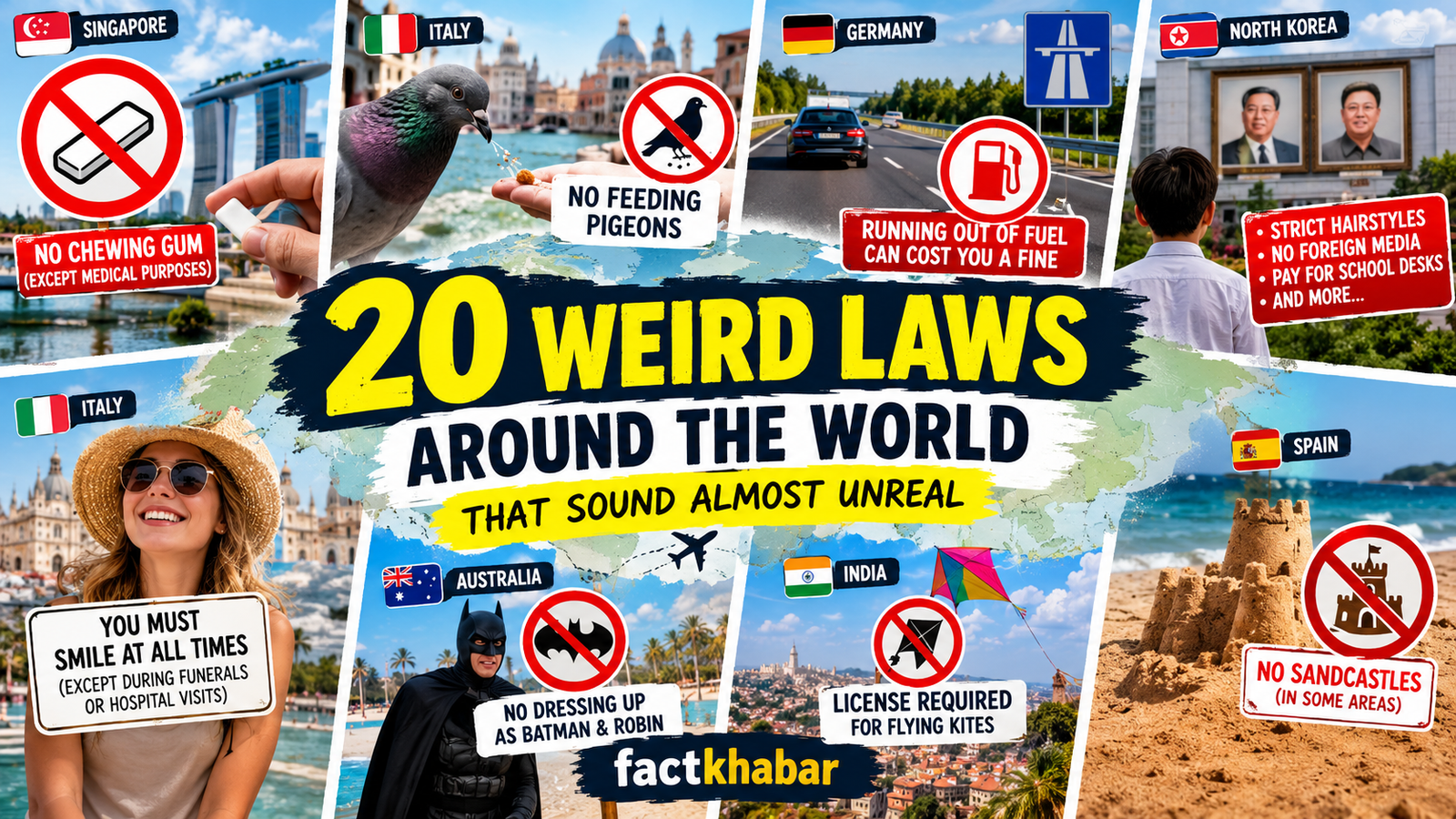
20 Weird Laws Around the World. Every country has its own laws, traditions, and rules, but some laws around the world are so unusual that they can leave people completely surprised. From restrictions on chewing gum to strange rules about public behavior, these laws show how differently countries approach everyday life. While some rules were introduced to maintain cleanliness and public order, others are linked to local traditions, historical events, or specific social concerns.
In this article, we will explore 20 weird laws from different countries that sound almost unbelievable. However, it is important to remember that some popular stories about unusual laws are outdated, exaggerated, or misunderstood. The examples below include a mix of well-known restrictions and unusual legal rules, with context to help explain them.
1. Chewing Gum Restrictions in Singapore
Country: Singapore
Singapore is famous for its strict public cleanliness rules, and its restrictions on chewing gum are among its best-known regulations. The country introduced controls on gum imports and sales to prevent discarded gum from damaging public spaces, especially public transport systems. Chewing gum itself is not generally illegal, and approved therapeutic gum is available under specific conditions. The rules mainly focus on importing and selling gum without authorization. This unusual policy demonstrates how seriously Singapore approaches cleanliness and public maintenance.
2. Feeding Pigeons Is Restricted in Venice, Italy
Country: Italy
Venice is one of the world’s most famous tourist destinations, known for its canals, historic buildings, and beautiful public squares. However, feeding pigeons in public places has been prohibited under local rules. Although feeding birds may seem like a harmless activity, large pigeon populations can create sanitation problems and damage historic monuments through their droppings. The restriction helps protect Venice’s cultural heritage and keep public areas cleaner. Visitors who want to enjoy the city’s atmosphere should admire the birds without feeding them.
3. Germany’s Unusual Rule About Escaping Prison
Country: Germany
Germany has an interesting legal principle concerning prison escapes. Escaping from prison is generally not a separate criminal offense when a person acts alone, without committing additional crimes. This principle is often explained through the idea that human beings naturally desire freedom. However, it does not mean prisoners can simply leave without consequences. Damaging property, threatening others, assaulting people, or committing other offenses during an escape can lead to additional legal penalties. Authorities can also take measures to prevent further escape attempts.
4. You Can Be Fined for Running Out of Fuel on Germany’s Autobahn
Country: Germany
Germany’s Autobahn network is famous for sections without a general speed limit for passenger cars. However, drivers must follow important safety rules. Running out of fuel on the Autobahn can result in a penalty because it is generally considered a preventable problem rather than an unavoidable emergency. A stationary vehicle can create a dangerous situation for other drivers, especially on high-speed roads. Anyone planning a long journey through Germany should check their fuel level before entering the Autobahn and stop at a service station when necessary.
5. Singapore Has Strict Public Toilet Rules
Country: Singapore
Singapore takes public hygiene seriously, and public toilet regulations are an important part of its approach to cleanliness. Certain offenses involving public toilets, including failing to flush after use where the applicable rules require it, can result in penalties. These measures encourage people to maintain shared facilities and show consideration for other users. Although forgetting to flush may seem like a minor mistake, public hygiene regulations are designed to keep frequently used spaces clean, safe, and pleasant for everyone.
6. Some Canadian Payments Cannot Be Made Entirely With Coins
Country: Canada
Canada has rules limiting how much a person can pay using coins in a single transaction. The exact limit depends on the type and denomination of the coins involved. For example, Canadian law places limits on the legal-tender status of different coins, meaning a large payment made entirely with small coins may not have to be accepted as legal tender. This does not mean that every payment above a particular amount is automatically illegal when made with coins. The rule is intended to establish reasonable boundaries for cash transactions.
7. Public Behavior Laws in the United Arab Emirates
Country: United Arab Emirates
The United Arab Emirates has laws addressing offensive language, insulting behavior, and public conduct. Swearing at another person, particularly when it involves insults or abusive gestures, can create legal problems depending on the circumstances. These rules reflect the country’s emphasis on public respect and social behavior. Visitors should remember that expressions considered ordinary in one culture may be treated more seriously in another. Understanding local customs and communicating respectfully can help travelers avoid unnecessary trouble during their stay.
8. Restrictions on Face Coverings in Denmark
Country: Denmark
Denmark introduced a law in 2018 restricting face coverings that hide a person’s face in public places, with exceptions for certain situations. The rule has often been discussed in connection with garments that cover the face, rather than ordinary protective masks in every circumstance. Religious clothing, cultural practices, and personal freedom have all been part of the public debate surrounding this legislation. The law illustrates how countries sometimes balance individual choices against their own views on public interaction and social policy.
9. Camera Shutter Sounds on Phones in South Korea
Country: South Korea
South Korea has taken measures to discourage people from secretly photographing others in private or sensitive situations. Camera shutter sounds on many phones sold in the country have traditionally been required or standardized under industry guidelines. The purpose is to make photography more noticeable and reduce the possibility of hidden-camera abuse. However, it is misleading to say that every phone in South Korea is legally incapable of turning off its camera sound in every situation. The broader issue is the country’s effort to address privacy concerns and unauthorized photography.
10. Rules About Taking Photographs at Sri Lanka’s Religious Sites
Country: Sri Lanka
Sri Lanka is home to many Buddhist temples and sacred sites that attract visitors from around the world. Tourists are expected to behave respectfully when visiting these places, and certain photographic poses, particularly those showing disrespect toward Buddha statues, may cause serious offense. Turning one’s back to a Buddha image for a photograph can be considered disrespectful in some settings. Visitors should follow posted signs, ask permission when uncertain, and avoid poses that could be interpreted as insulting religious beliefs. Respecting local traditions makes travel more enjoyable for everyone.
11. The Strange History of Laws About Mustaches in the United States
Country: United States
The United States has a reputation for unusual local laws, and stories about strange rules involving mustaches often circulate online. One frequently repeated example claims that men with mustaches were prohibited from kissing women in certain circumstances. However, many such stories are difficult to verify or refer to outdated local ordinances. The country has thousands of state and local governments, and their rules can differ considerably. This is why unusual American laws should be checked against official legal sources before being treated as current requirements.
12. Excessive Honking Can Lead to Fines in New York City
Country: United States
In New York City, drivers cannot freely use their car horns whenever they feel impatient. Traffic rules restrict unnecessary horn use, and excessive or improper honking can result in a fine. The purpose is to reduce noise pollution in one of the world’s busiest urban environments. Although a horn is important for warning others about immediate danger, using it to express frustration or repeatedly pressure traffic to move is a different matter. This law encourages drivers to use their horns responsibly.
13. Restrictions on Kite Flying in India
Country: India
Kite flying is a popular tradition in India, especially during festivals and celebrations. However, certain types of kites and flying materials are subject to legal restrictions because they can pose risks to people, birds, and electrical infrastructure. Authorities have also taken action against dangerous kite strings that can cause serious injuries. Rules differ across states and local areas, so it is inaccurate to assume that every kite requires the same license throughout the country. Before flying kites, people should check applicable local regulations and use safe materials.
14. Restrictions on Dancing in Certain Mumbai Establishments
Country: India
Mumbai has experienced a long-running debate over dancing in bars and entertainment establishments. At different times, state regulations and court decisions have affected whether certain establishments could legally offer dance performances. These restrictions have changed over the years, making it misleading to claim that dancing is universally prohibited in all bars across Maharashtra today. The history of these rules reflects debates about public morality, business regulation, workers’ rights, and the freedom of entertainment venues to operate. It is an example of how laws can evolve as courts and governments reconsider earlier policies.
15. North Korea’s Strict Restrictions on Hairstyles and Clothing
Country: North Korea
North Korea is known for extensive government control over many aspects of public life. Reports have frequently described restrictions on clothing, hairstyles, and personal appearance, although viral claims about a single official list of exactly 28 permitted haircuts should be treated cautiously. The country’s political system places significant emphasis on conformity and state-approved public behavior. Clothing associated with foreign cultural influences can also attract scrutiny in certain circumstances. These restrictions illustrate how personal choices that are ordinary in many countries may be subject to greater political and social control elsewhere.
16. North Korea Has Extremely Limited Internet Access
Country: North Korea
Internet access in North Korea is very different from what people experience in most parts of the world. The general population has highly restricted access to the global internet, while some people can use a domestic computer network containing selected websites and information services. Access to international websites and communication systems is tightly controlled. Claims that the country has exactly 28 websites are often repeated online, but the number and availability of accessible sites can change. The important fact is that ordinary citizens do not enjoy unrestricted access to the worldwide web.
17. Public Rules About Dirty Cars in Russia
Country: Russia
Stories about laws against driving dirty cars in Russia have circulated for years, but the reality is more complicated. A dirty vehicle is not necessarily illegal simply because its exterior is covered in mud. However, a vehicle can violate safety requirements if dirt, snow, or other material obscures its number plates, lights, or other essential features. Drivers are expected to keep their vehicles in a condition that allows them to be identified and operated safely. This is a useful reminder that some supposedly bizarre laws have a more practical explanation.
18. Sandcastle Rules on Spanish Beaches
Country: Spain
Building a sandcastle on a beach sounds like one of the simplest pleasures of a holiday, but some Spanish coastal areas have local regulations governing beach activities. Depending on the municipality, restrictions may apply to digging large holes, obstructing public areas, damaging protected dunes, or leaving structures behind. Fines reported in popular articles may relate to particular local rules rather than a nationwide ban on ordinary sandcastles. Families visiting Spanish beaches should follow local signs and avoid activities that damage the natural environment or interfere with other beachgoers.
19. The Unusual History of Laws About Farting in Malawi
Country: Malawi
One of the strangest stories about laws around the world claims that Malawi once made farting illegal. The story became popular because it sounds almost impossible to believe. However, the claim that the country introduced a general law prohibiting ordinary flatulence is not reliably established. It is a good example of how humorous internet lists can turn political discussions, jokes, or misunderstood statements into supposed legal facts. Before accepting an unusual law as real, it is always worth checking whether reliable sources or official legal records support the story.
20. Strict Rules About Media and Public Life in North Korea
Country: North Korea
North Korea imposes extensive restrictions on foreign media, including films, television programs, and music. Unauthorized access to or distribution of foreign entertainment can carry serious penalties, depending on the circumstances and the laws being enforced. The government also restricts international travel and tightly controls political expression and information. Reports of severe punishments for watching prohibited media have drawn international concern, although individual cases should be evaluated carefully because details can be difficult to verify independently. These rules demonstrate how government policies can influence even private entertainment choices.
Conclusion
These 20 examples show that laws around the world can be very different from what people expect. Some focus on cleanliness and public safety, such as Singapore’s gum restrictions and rules against unnecessary honking in New York City. Others reflect cultural traditions, religious respect, or strict government control, as seen in rules concerning sacred places in Sri Lanka and media access in North Korea.
However, not every unusual law shared on the internet is accurate or still in force. Some stories are based on old regulations, local restrictions, or exaggerated retellings. If you are planning to travel abroad, the best approach is to research current official rules for your destination. A little preparation can help you avoid unexpected fines, respect local customs, and enjoy discovering the fascinating differences between countries.