
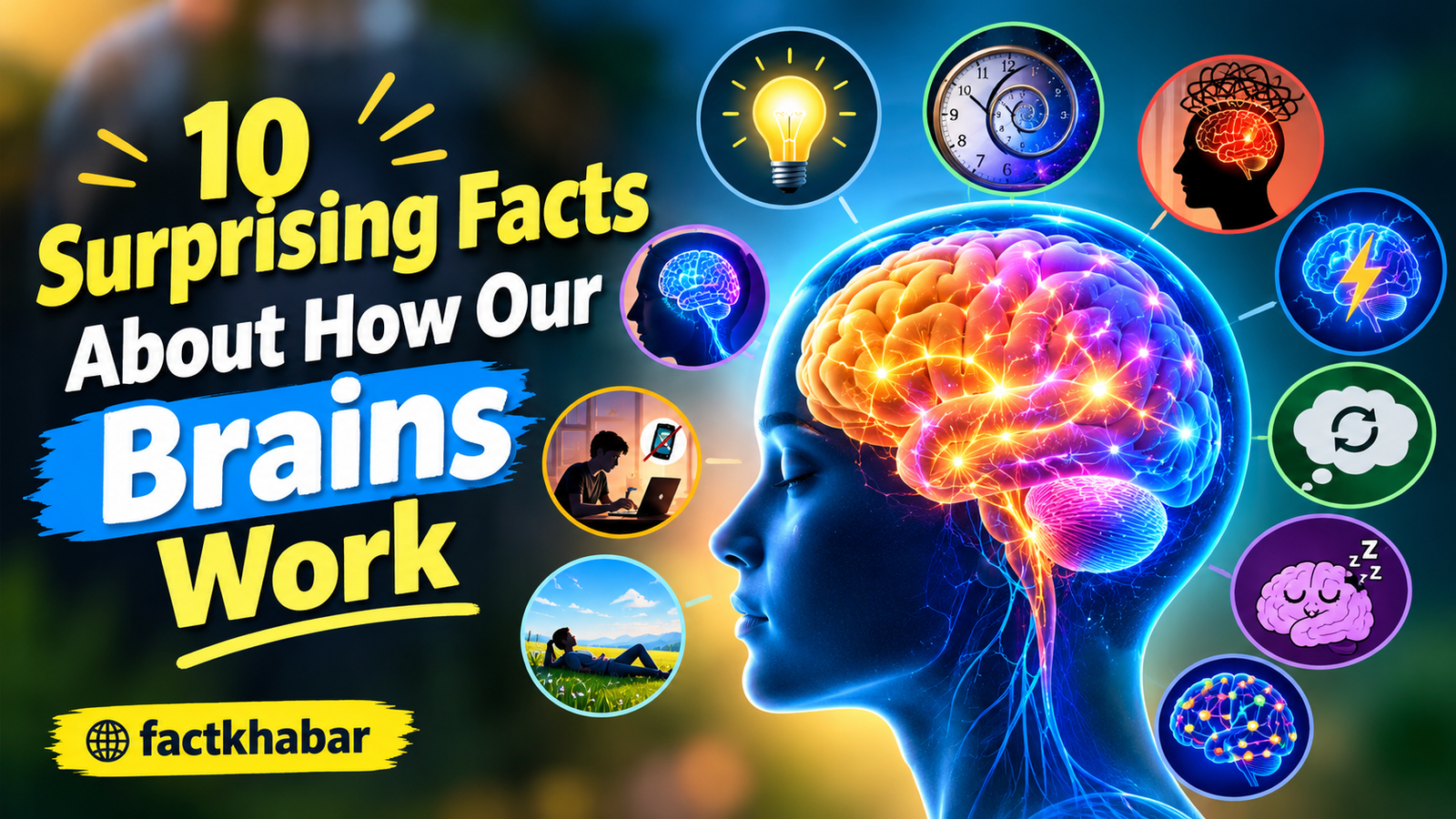
The human brain is one of the most fascinating and complex organs in the body. It controls our thoughts, emotions, memories, movements, and ability to learn new things. Every day, our brains process a huge amount of information, helping us understand the world around us and respond to different situations. However, many people do not realize how much is happening inside their heads every second. From the way we perceive time to how sleep affects our memory, the brain has several surprising abilities that scientists continue to study. Understanding how our brains work can help us learn more about human behavior, improve our daily habits, and appreciate the incredible system that makes us who we are. Here are ten surprising facts about the human brain that reveal some of its most interesting features.
1. Your Brain May Become More Creative When You Are Tired
Have you ever noticed that your mind starts wandering when you are tired? You might suddenly think of a new idea, imagine an interesting story, or feel inspired to write or draw. This happens partly because tiredness can affect attention and reduce the mental control we normally use to focus on specific tasks. When our minds are less focused on strict rules, we may sometimes make unusual connections between ideas. However, this does not mean that being tired always makes us more creative. Sleep deprivation can weaken concentration, memory, and decision-making, making difficult tasks harder to complete. The relationship between tiredness and creativity depends on the person and the activity. For example, a relaxed mind may help with brainstorming, while demanding analytical work usually benefits from proper rest and concentration. If you want to encourage creativity, try allowing yourself some quiet time, taking short breaks, and getting enough sleep rather than deliberately staying awake for long hours. 10 Surprising Facts About How Our Brains Work
2. New Experiences Can Change How You Perceive Time
Have you ever felt that a holiday passed incredibly quickly while you were enjoying it, but seemed to last much longer when you looked back on it? Our perception of time is not always the same as the time measured by a clock. It can change depending on our attention, emotions, and experiences. When we do something familiar, our brains can process much of the information automatically because we already understand the situation. However, when we experience something new, we often pay closer attention to details, surroundings, and unfamiliar events. These experiences may create richer memories, making a particular day seem longer when we remember it later. Stressful or frightening situations can also make time feel slower because attention becomes strongly focused on what is happening. Interestingly, time can feel different while an event is taking place compared with how long it seems afterward. Trying new activities, exploring unfamiliar places, or learning a new skill can make everyday life feel more varied and memorable.
3. Long-Term Stress Can Affect Your Brain
Stress is a natural response that helps the body deal with challenges, pressure, and potential danger. In short periods, it can help us remain alert and respond quickly to difficult situations. However, when stress continues for weeks or months, it can affect several functions of the brain, including memory, concentration, and emotional regulation. Researchers have found that prolonged exposure to stress hormones can influence brain regions involved in learning and memory, particularly the hippocampus and the prefrontal cortex. Studies involving animals have also shown that chronic stress can produce changes in brain structure and activity. Research in humans suggests that long-term stress may be associated with changes in brain function, although the effects vary between individuals and are influenced by many factors. These changes do not mean that stress permanently damages everyone’s brain. Getting adequate sleep, exercising regularly, maintaining social connections, and taking time to relax can help support healthy brain function. If stress becomes overwhelming or begins interfering with everyday life, seeking professional support may also be beneficial.
4. Your Brain Uses Electrical Signals to Communicate
One of the most fascinating facts about the brain is that its cells communicate through electrical and chemical signals. Neurons, the specialized cells of the nervous system, send electrical impulses along their membranes and release chemical messengers called neurotransmitters to communicate with other cells. These signals allow the brain to process information, control movement, recognize sounds, and respond to the environment. The brain also consumes a significant amount of energy to maintain this constant activity. Although the brain represents only a small percentage of an adult’s body weight, it uses roughly 20% of the body’s resting energy expenditure under typical conditions. Its activity produces measurable electrical signals, which scientists can study using tools such as electroencephalography, commonly known as EEG. The brain is sometimes described as producing enough electrical power to light a small bulb, but such comparisons are simplified illustrations rather than a direct measure of how the brain operates. What makes the brain remarkable is not simply its electrical activity, but the enormous network of connections that allows billions of nerve cells to work together.
5. Your Brain Can Repeat the Same Thoughts Again and Again
Have you ever found yourself thinking about the same conversation repeatedly or worrying about something that happened several days ago? Repetitive thinking is a common human experience. Our brains are designed to recognize patterns, remember important events, and predict what might happen in the future. These abilities can help us solve problems and learn from our mistakes, but they can also lead us to revisit the same thoughts many times. For example, you might repeatedly consider what you should have said during an argument or worry about an upcoming examination. When these thoughts become difficult to control, they may turn into rumination or excessive worry. It is often claimed that people experience a specific number of thoughts every day and that most are repeated or negative, but these figures are not firmly established scientific facts. The important point is that repeated thinking is influenced by attention, emotions, habits, and stress. Writing down your concerns, focusing on the present moment, taking a walk, or discussing your worries with someone you trust may help you break an unhelpful cycle of thoughts.
6. Short-Term Memory Can Hold Information for Only a Limited Time
Your brain can remember information for different periods, depending on what you are learning and how you use it. Short-term memory allows you to keep information available for a brief time, such as remembering a phone number long enough to dial it. Working memory goes a step further by allowing you to hold and manipulate information while completing a task. For example, when you calculate a simple sum in your head, you use working memory to keep the numbers and results in mind. Without rehearsal or continued attention, some information may disappear within seconds. However, there is no single time limit that applies to every memory. How long information remains available depends on factors such as attention, distraction, familiarity, and the complexity of the task. Researchers have also found that working memory has a limited capacity, although the amount of information people can hold varies with the material and the circumstances. Repeating information, grouping related details together, and connecting new knowledge with things you already understand can make it easier to remember important information.
7. Humans Do Not Use Only 10% of Their Brains
The idea that humans use only 10% of their brains is one of the most popular myths about the human mind. It suggests that people could unlock extraordinary abilities if they learned to use the remaining 90%. However, scientific evidence does not support this claim. Brain imaging studies show that many different brain regions participate in everyday activities, including speaking, reading, remembering, moving, and experiencing emotions. Not every part of the brain is equally active at every moment, but different areas perform specialized functions and work together as needed. Even during sleep, the brain remains active and carries out important processes related to memory, regulation, and recovery. Some brain regions may become more active than others depending on the task, but this does not mean that the rest of the brain is unused. Brain injuries also demonstrate that specific areas can have important functions, as damage to particular regions may affect movement, language, sensation, or memory. The real potential of the brain lies in its ability to learn, adapt, and strengthen connections through experience, not in activating a supposedly unused portion.
8. Changes in Brain Chemistry Can Influence Headaches
Headaches can develop for many different reasons, and brain chemistry plays an important role in some types of headache, particularly migraines. Chemical messengers such as serotonin help nerve cells communicate and participate in processes that influence pain and sensory signals. Changes in these systems may be involved in migraine attacks, although migraines are complex neurological conditions rather than the result of a single chemical change. Hormonal fluctuations, especially changes in estrogen levels, can also contribute to migraines in some people. Other possible triggers include irregular sleep, dehydration, stress, certain foods, and changes in routine, although triggers differ from person to person. Pain-sensitive structures around the brain, including blood vessels, membranes, and nerves, can contribute to headache symptoms. Keeping track of when headaches occur, how long they last, and what happens before them may help identify personal patterns. Frequent or severe headaches should be discussed with a healthcare professional. A sudden, extremely severe headache or a headache accompanied by new neurological symptoms requires urgent medical attention.
9. The Brain Cannot Fully Focus on Multiple Demanding Tasks at Once
Many people believe they are good at multitasking because they can switch between texting, studying, watching videos, and answering questions. However, when two activities require focused attention, the brain often switches between them instead of performing both tasks simultaneously. This process is called task-switching. Every time you move from one demanding activity to another, your brain may need time to adjust its attention and remember what you were doing. Frequent switching can reduce efficiency, increase mistakes, and make it harder to understand or remember information. For example, a student who repeatedly checks social media while studying may take longer to finish an assignment and may remember less of what they read. Some activities, such as walking while having a simple conversation, can often be performed together because they do not require the same level of attention. However, tasks that demand concentration, such as driving while using a phone, can be particularly dangerous. Focusing on one important task at a time, silencing unnecessary notifications, and taking planned breaks can help improve productivity and reduce avoidable errors.
10. Short Naps Can Support Learning and Memory
Sleep is essential for healthy brain function, and even a short nap can sometimes help improve alertness and concentration. During sleep, the brain continues working on processes that support learning, memory, and emotional regulation. Research suggests that naps can improve certain aspects of memory and learning, particularly when someone is tired or has been concentrating for a long period. A brief nap may also help people feel more refreshed and attentive during the rest of the day. However, the benefits depend on factors such as nap duration, sleep quality, and the individual’s usual sleep schedule. Short naps of around 10 to 20 minutes are often useful for improving alertness without causing much grogginess afterward. Longer naps may provide additional benefits in some circumstances, but waking from deeper sleep can temporarily make a person feel disoriented. Napping is not a complete replacement for sufficient nighttime sleep, which remains important for overall health and brain performance. If you have been studying for an examination or working on a demanding project, taking a short nap may be helpful when you feel tired. Maintaining a regular sleep schedule is one of the most effective ways to support your brain over time.
Conclusion
The human brain is an extraordinary organ that influences nearly every part of our lives, from the way we remember information to how we experience emotions and make decisions. These ten surprising facts show that brain function is closely connected to sleep, stress, attention, memory, and everyday experiences. Although some popular claims about the brain are exaggerated or misleading, scientific research continues to reveal how its complex networks help us learn, adapt, and respond to the world. Understanding these processes can also encourage healthier habits, such as getting enough sleep, managing stress, exploring new experiences, and focusing on important tasks without unnecessary distractions. By taking care of our brains and staying curious about how they work, we can better understand ourselves and appreciate the remarkable abilities of the human mind.