
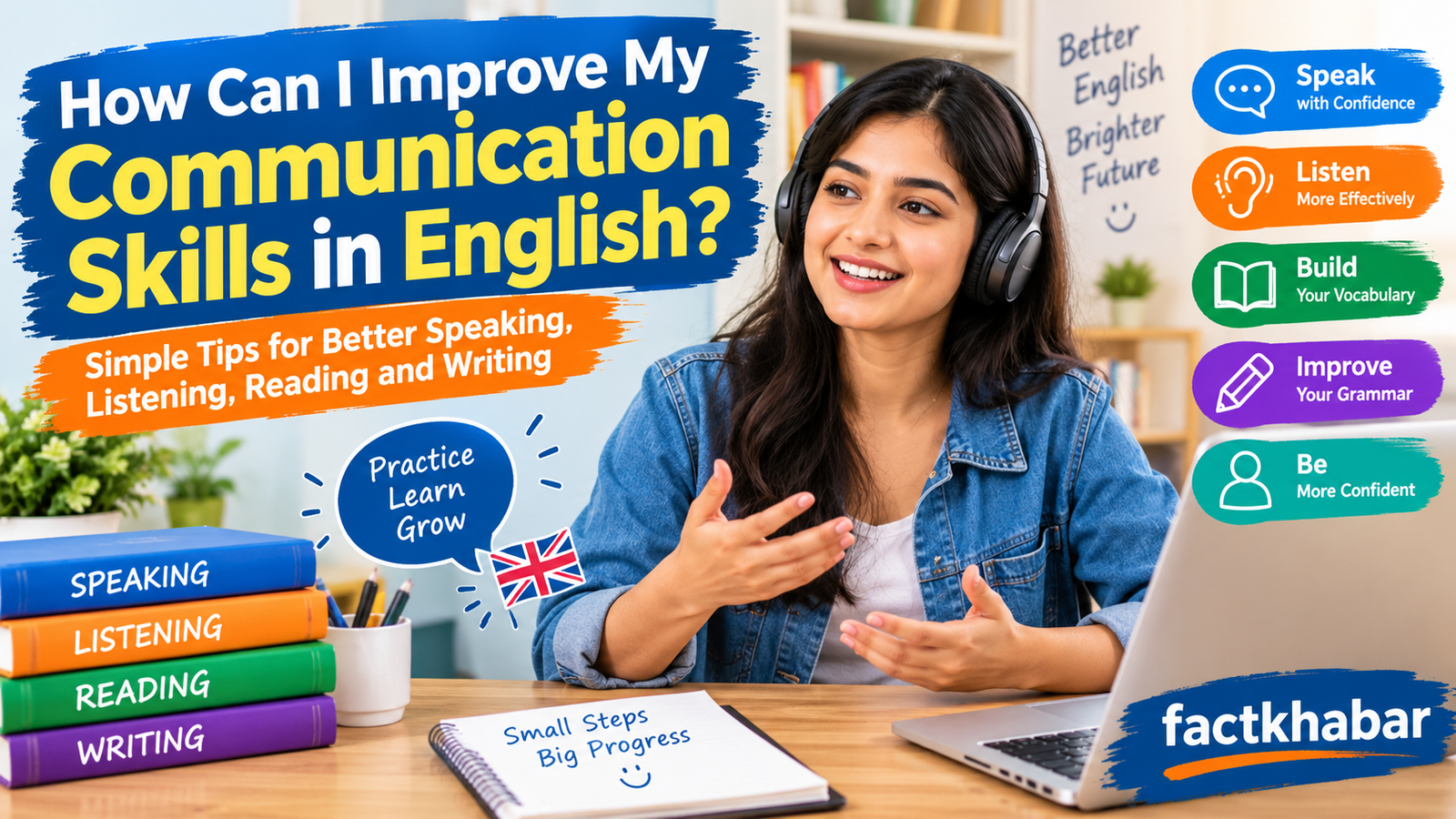
Good communication skills can make a huge difference to your personal, academic, and professional life. So, whether you are a student, job seeker, employee, business owner or someone learning English for everyday conversations, being able to express yourself clearly can help boost your confidence.
If you often wonder, “How can I improve my English communication skills?” the good news is that you don’t have to be fluent overnight. Then communication gets better and better with practice, practice, practice, listening, reading, speaking and learning from mistakes.
This guide gives you simple and practical ways to improve your English communication skills and to feel more comfortable using English in real-life situations.
What Is Communication Skills In English
Communication Skills in English means your ability to communicate and comprehend ideas effectively in spoken and written English. Some of these are key areas such as:
- Say it out loud.
- Hearing in detail
- Using suitable vocabulary
- Understanding of grammar
- Pronunciation – saying words correctly
- Making sense sentences
- Effective use of body language
- Confidence to express opinions and ideas
You don’t need perfect grammar or a big vocabulary to get your meaning across. The primary goal is to convey your point clearly and make it easy for the reader to understand.
1. Speak English every day
One of the best ways to improve your English communication skills is to speak regularly.
Many students can understand English when they read or listen, but are afraid to speak it. It is often because they are afraid of making mistakes.
Don’t wait until your English is perfect; begin talking with the vocabulary that you already know.
You can discuss easy topics such as:
- What you did today
- Your tomorrow plans
- Your favourite cuisine
- Your interests
- Your family.
- Your job or studies
- A movie you watched recently
Talk for five to ten minutes every day. Slowly increase the time.
Sample Practice
Rather, tell yourself, “I am not good enough at English,” and then:
“I rose early this morning. Ate breakfast and got to work. In the evening I went for a walk.”
When you are building confidence, it is okay to use simple sentences.
2. Enhance your English listening abilities
Good communication is not just talking. Listening is also important.
When you listen closely, you learn how native and fluent English speakers pronounce words, build sentences, use expressions, and respond in conversations.
You can practise listening with:
- Interviews English
- Podcasts Podcasts
- Documentaries
- Education Videos
- News broadcasts
- English films and serials
- Audio books
Start with material that you can easily understand. Use English subtitles if something is too hard.
Try listening to the same short video multiple times. In the first listening focus on the general meaning. In the second listening, try to catch individual words and phrases.
3. Study Useful Vocabulary Not Random Words
Better vocabulary can facilitate expressing your thoughts.
But learning long lists of unrelated words isn’t always useful. Instead, learn words and phrases that you can actually use in every day conversations.
Instead of just learning the word “recommend,” learn a useful sentence:
“Are there any good restaurants around?
Likewise, learn phrases like:
“I think…”
“I agree with you.”
“Can you make that clear?”
“What do you mean?
“As far as I’m aware…”
“I’d like to add something.”
“That sounds cool.
He thought for a moment.
Learning vocabulary in context makes it easier to remember and use it naturally.
4. Read every day in English
Reading is a good way to improve your English communication skills.
Regular reading exposes you to new vocabulary, sentence structures, expressions and styles of writing.
You can start off with material that is at your level, such as:
- Short stories:
- Blogs
- News stories
- Magazine
- easy books
- Online teaching resources
Don’t stop to check the meaning of every second word. First, try to understand the overall meaning from the context.
Keep a little notebook for new words and write down useful vocab and example sentences.
5. Get into the habit of thinking in English
Many learners of English take a sentence in their own language and translate it into English. That can make it seem slower and less natural.
One useful way is to slowly train yourself to think directly in English.
For example, upon waking up, think:
I have to get ready for work.
When you make breakfast:
I am making coffee.
When you plan your day:
“I got a meeting at ten o’clock.”
These sentences might look really easy, but they help your brain get used to understanding English without having to translate everything all the time.
6. Improve Your Pronunciation
Clear pronunciation makes it easier for other people to understand you.
You don’t have to necessarily copy a particular accent. The aim should be understandable and confident pronunciation.
Pick a short English sentence from a video and listen carefully. Then try to repeat it several times, trying to follow the speaker’s rhythm and pronunciation.
This technique is often referred to as shadowing.
For example:
Hear the sentence.
Cut the audio.
Say this sentence again.
Listen again.
Compare your talking.
Keep doing it until it feels comfortable.
Pay special attention to the words you tend to mispronounce most often.
7. How to Improve Your Grammar Step-by-Step
Grammar is important because it helps you communicate what you want to say. But you don’t have to learn every single grammar rule before you start speaking.
Start with practical areas such as:
- Present, Past and Future tense
- Agreement of subject and verb
- Topics
- Prepositions
- Questions formation
- Common sentence structures to
Know the difference between
“I go to work each day.”
and.
“Yesterday I went to work.”
Learning grammar from examples can be more useful than memorising complicated definitions.
8. Record yourself, Practice English speaking
One simple way to find out where you need to improve is to record yourself.
Pick a topic and talk for two or three minutes. Use your phone to record your voice.
Listen to the recording then ask yourself:
Do I make myself clear?
Did I pause too long?
Did I use the same words?
Are my sentences clear?
Did I say any words wrong?
Can I say what I think in a better way?
Don’t be disheartened when you hear mistakes. The point of tracking is to see how you’re doing and what you can do better.
9. Have Conversations With Other People
Real conversations are really important, as they teach you how to respond naturally.
Practice English with:
Friends Colleagues Teachers Language partners Classmates
Speaking Groups Online
Instead of trying to memorise answers you have prepared, try to have a conversation.
Ask questions, answer what the other person says, and learn how to keep a conversation going.
For instance:
Person A: “What do you like to do in your free time?”
Person B: “I like watching films and listening to music. How about you?”
This kind of practice helps you develop conversational skills in a natural way.
10. Stop Being Scared of Mistakes
The fear of making mistakes is one of the biggest stumbling blocks for English learners.
Language learning is about making mistakes and learning from them.
If you say something wrong, learn the right way and try again. ‘Every mistake can tell you what you need to work on.
Don’t try to speak perfect English; instead, try to communicate your message clearly.
Confidence usually comes with practice, not with waiting to be perfect.
11. Utilise English in your daily life
You can create chances to practise English without spending hours studying.
Try changing little things in your daily routine.
For example:
- Make your shopping list in English.
- Keep a diary in English language.
- Read the English news.
- Tell me what you do in English?
- Search for information in English.
- Create social media messages in English.
- Speak to yourself in English.
- Watch English learning videos.
The more you use English, the more familiar it becomes.
12. Maintain a Simple Daily Practice Routine
It is better to be consistent than to study a few hours once a week.
A simple daily routine can look like:
- Activity Time
- Listening practice 15 Min
- Reading 15 minutes
- Interview 15 minutes
- Vocabulary 10 minutes
- writing 5 minutes
You may change this schedule as per your time and ability.
Even 30 minutes of focused English practice every day can help if you stick to the habit consistently.
Pitfalls to Avoid
As you develop your communication skills, avoid these common habits:
Trying To Memorise It All
You don’t need to memorise thousands of words. Focus on useful vocabulary and expressions.
Focusing Only on Language
Communication. Grammar matters, but so does practice in speaking and listening.
Comparing yourself to fluent speakers
Each person learns at their own speed Measure your present ability against your own past progress.
Avoiding Conversation
You will learn faster when you actually use English.
Giving Up Too Quickly After Mistakes
You cannot learn without making mistakes. View them as opportunities to improve.
How Long Does It Take to Improve Your English Communication Skills?
There is no fixed time frame. It is contingent upon your level, how much you practise, how much you are exposed to English and how consistent you are.
Someone who practices their English regularly will move on faster than someone who studies it in fits and starts.
Set small goals, instead of just thinking about how many days it will take.
For instance:
Week 1: Practice speaking English for 5 minutes daily.
Week 2: Master 20 useful phrases and use them.
Week 3: Make 3 short English conversations.
Week 4: Film yourself speaking for 5 minutes.
Small improvements can add up to much greater confidence over time.
Concluding thoughts
If you are thinking about how I can improve my communication skills in English, then start simple and consistent practice. Every day, speak, listen carefully, read regularly, learn useful vocabulary, improve your pronunciation and don’t be afraid of making mistakes.
You don’t need perfect English to be an effective communicator. You should try to express your ideas clearly, listen to others and gain confidence with every conversation.
Most importantly, you have to start using English today. Even just a few minutes of talking practice can become a useful habit when you keep doing it regularly.