
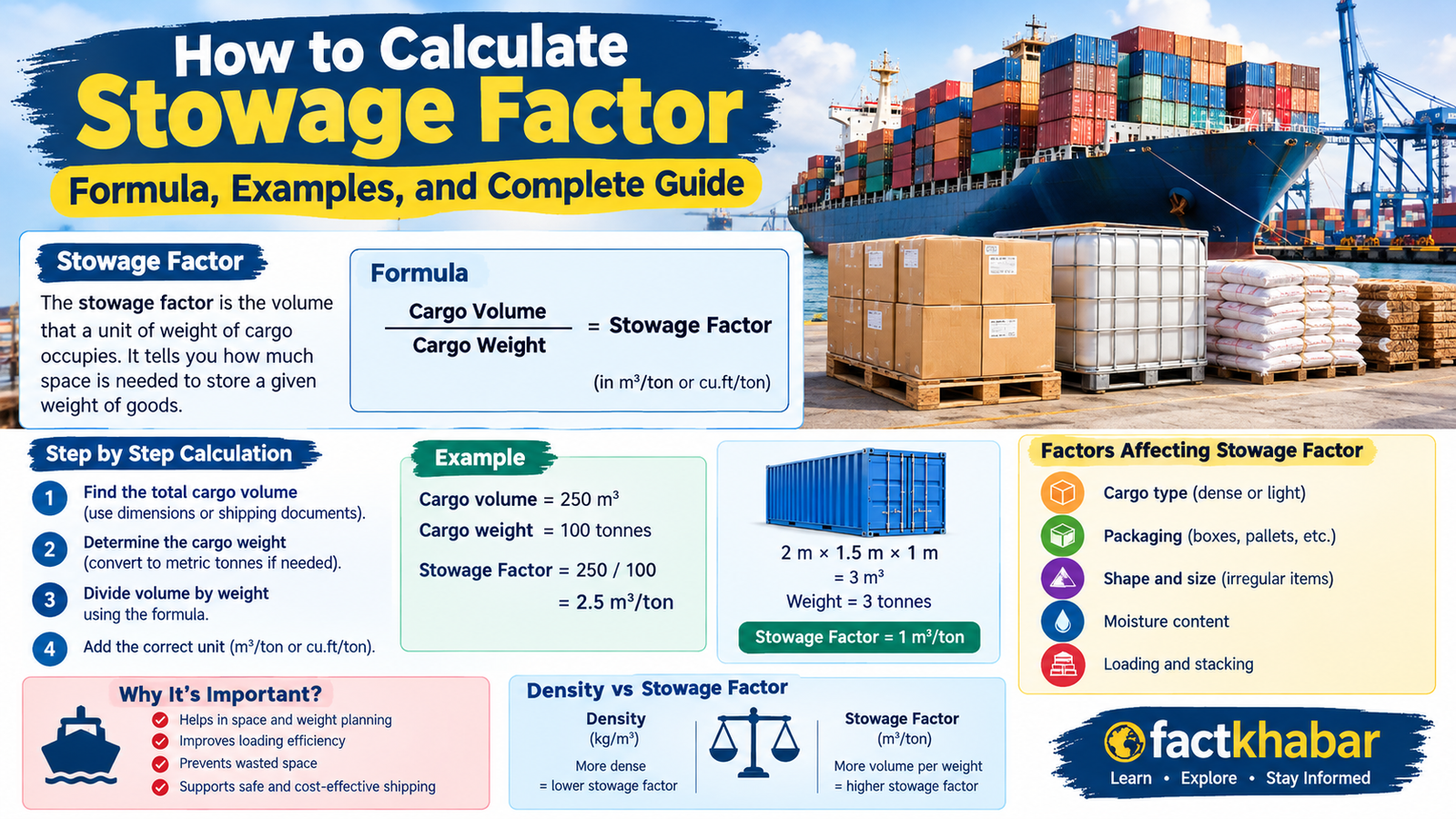
How to Calculate Stowage Factor: It’s important to know how to calculate the stowage factor in shipping, cargo transportation, and maritime logistics. It assists ship operators, cargo planners, freight forwarders, and exporters in calculating how much space a particular cargo type will occupy within a ship or a cargo container. With proper calculation, we can improve the loading of cargo, reduce wasted space, and make the transportation more efficient.
Different types of cargo require different quantities of space. One tonne of iron ore takes up far less space than one tonne of cotton or plastic products, for example. This difference can be attributed to the stowage factor, which is a measure of the volume required to stow a given weight of cargo.
In this guide, you will learn the meaning of stowage factor, the formula, how to calculate it step by step, and why it is important in shipping operations.
What is the Stowage Factor?
The stowage factor is the volume that a unit of weight of cargo occupies. Basically, it tells you how much space you need to store a given weight of goods. In shipping, the stowage factor is usually quoted in cubic meters per metric tonne (m3/ton) or in cubic feet per long tonne, depending upon the system of measurement.
For example, a metric tonne of cargo that occupies 2 m³ has a stowage factor of 2 m³/ton. Cargo takes up less space for the same weight when you have a stowage factor of 0.5 cu.m. per metric tonne. It is particularly useful in the preparation of shiploads, calculating the amount of cargo that can be carried, and in comparing different kinds of goods. “How to Calculate Stowage Factor“
The stowage factor formula
The basic formula to calculate stowage factor is:
Cargo Volume / Cargo Weight = Stowage Factor
Where at:
Cargo Volume: The total volume of the cargo expressed in cubic meters or cubic feet.
Weight of Cargo: The total weight of the cargo in metric tonnes or other consistent unit of weight.
Units of volume and weight should be consistent with units in the final answer. For example, cubic meters divided by metric tonnes gives a stowage factor in m 3 /tonne.
Stowage Factor Calculation Step by Step
The stowage factor is easily calculated when the volume and weight of the cargo are known. Do the following and get the result.
Step 1: Determine the total cargo volume. First, add up the space occupied by the cargo. The volume may be stated in the shipping documents or calculated from the cargo’s dimensions. The volume of a rectangular prism can be calculated by multiplying length, width, and height. Make sure all dimensions are in the same units.
- Determine the cargo weight. Determine the total weight of the goods in metric tonnes. If the weight is in kilograms, then divide by 1000 to convert to metric tonnes.
Step 3: Use the formula. Divide total cargo weight by total cargo volume.
Step 4: Write the correct unit. Convert to cubic meters per metric tonne (m3/ton) when the volume is in cubic meters and the weight is in metric tonnes.
By carrying out these steps, you will be able to calculate the stowage factor accurately and know the space required for cargo transportation.
Example 1. Calculation of Stowage Factor for G.C.
For instance, let’s say there is a shipment of 100 metric tonnes of cargo, and the total volume of the goods is 250 cubic meters.
Here is the information:
Cargo volume: 250 cbm
Cargo Weight: 100 MT
With the formula:
Stowage Factor = Volume of cargo / Weight of cargo
Stowage Factor = 250/100
Stowage Factor = 2.5 cu.m. /tonne
This means that each metric tonne of cargo takes up an average of 2.5 cubic meters. This figure can be used by a shipping planner to estimate the volume needed for a comparable amount of cargo, assuming the packaging and loading conditions are similar.
Example 2. Finding the Stowage Factor from the Dimensions of the Cargo
Imagine a rectangular package 2 meters long, 1.5 meters wide, and 1 metre high. It weighs 3 metric tonnes.
First, calculate the volume of the package:
Volume = Length * Width * Height
Volume = 2 x 1.5 x 1 = 3.
Volume = 3 m^3
Now work out the stowage factor:
Stowage Factor = 3/3
Stowage Factor = 1 m3/tonne
This means that each metric tonne of this cargo occupies 1 cubic metre of space according to the external dimensions of the package. If you have multiple packages, add up the volumes and divide by the total cargo weight.
Factors affecting stowage factor
There are a number of factors that may influence the stowage factor of cargo in shipping. Cargo Type: Dense materials such as iron ore and steel products generally have lower stowage factors than lightweight materials such as cotton, foam, and certain plastic products.Packaging: Boxes, pallets, protective materials, and other packaging can add to the overall volume of a shipment. Shape and Size: Irregularly shaped cargo can create spaces between items, reducing the amount of usable cargo space on a ship’s hold.
Moisture Content: For some bulk commodities, moisture can change the cargo weight without a corresponding change in volume, affecting the calculated stowage factor.Loading and Stacking. The actual space required can be affected by the arrangement of the goods. Improper cargo arrangement may cause unused spaces and reduce loading efficiency.
It is also worth noting that the stowage factor of any cargo is the calculated space it will occupy and must be distinguished from the space it will actually require when the effect of packaging, gaps, and the ship’s structural limitations have been taken into account.
Why is the Stowage Factor Important in Shipping?
The stowage factor is of great importance in planning cargo and maritime transportation. It helps shipping professionals estimate if a shipment is more likely to use the available cargo volume or reach a vessel’s weight limit first. Cargo with a high stowage factor needs more space per metric tonne. Such cargo can fill the available hold before the vessel reaches the maximum allowed cargo weight. By way of contrast, dense cargo with a low stowage factor can reach a weight limit with much space remaining unused.
The stowage factor also helps when planning goods, estimating cargo space, making decisions about loading, and comparing different shipments. But the final loading plan must take into account the capacity of the vessel, distribution of the cargo, stability, safety requirements, and any rules that may apply to the cargo.
Density Difference vs Stowage Factor
Density and stowage factor are related, but they are inversely related. Density is a quantity of mass per volume. It is the volume taken up by a unit of weight. Stowage factor . For example, density is expressed in kilograms per cubic metre (kg/m 3), while stowage factor is usually expressed in cubic metres per metric tonne (m 3 /tonne).
The greater the density, the lower the stowage factor for the same basis of measurement of the cargo. In practice, the stowage factor used in shipping may be affected by packaging and space between cargo items.
Things to Avoid
Units of measurement are often confused. For example, if you want cargo volume in cubic feet to be expressed as m³/ton, you cannot simply divide it by weight in metric tonnes. Convert units first. Another mistake is to quote the volume of a single package when the shipment consists of more than one package. Always use total volume and total weight of cargo for the same group of goods.
It should also be noted that the physical volume of the cargo does not equal the total available capacity of the hold of a ship. The calculated stowage factor gives the relationship between the cargo volume and weight. The actual loading arrangement depends on the space available and the operational restrictions.
Conclusion:
If you are involved in shipping, goods forwarding, cargo handling, or maritime logistics, you must know how to determine the stowage factor. The formula is simple. Total volume of cargo / total weight of cargo. The result indicates the space required per unit weight.
You can improve the calculation of the stowage factor by using consistent measurement units, checking the dimensions of the cargo, and taking into account the packaging and loading conditions. This information contributes to better cargo planning, space requirement estimation, and utilisation of shipping capacity.
If you study maritime operations or work in the shipping industry, knowing the stowage factor is a useful skill to handle cargo efficiently and safely.