
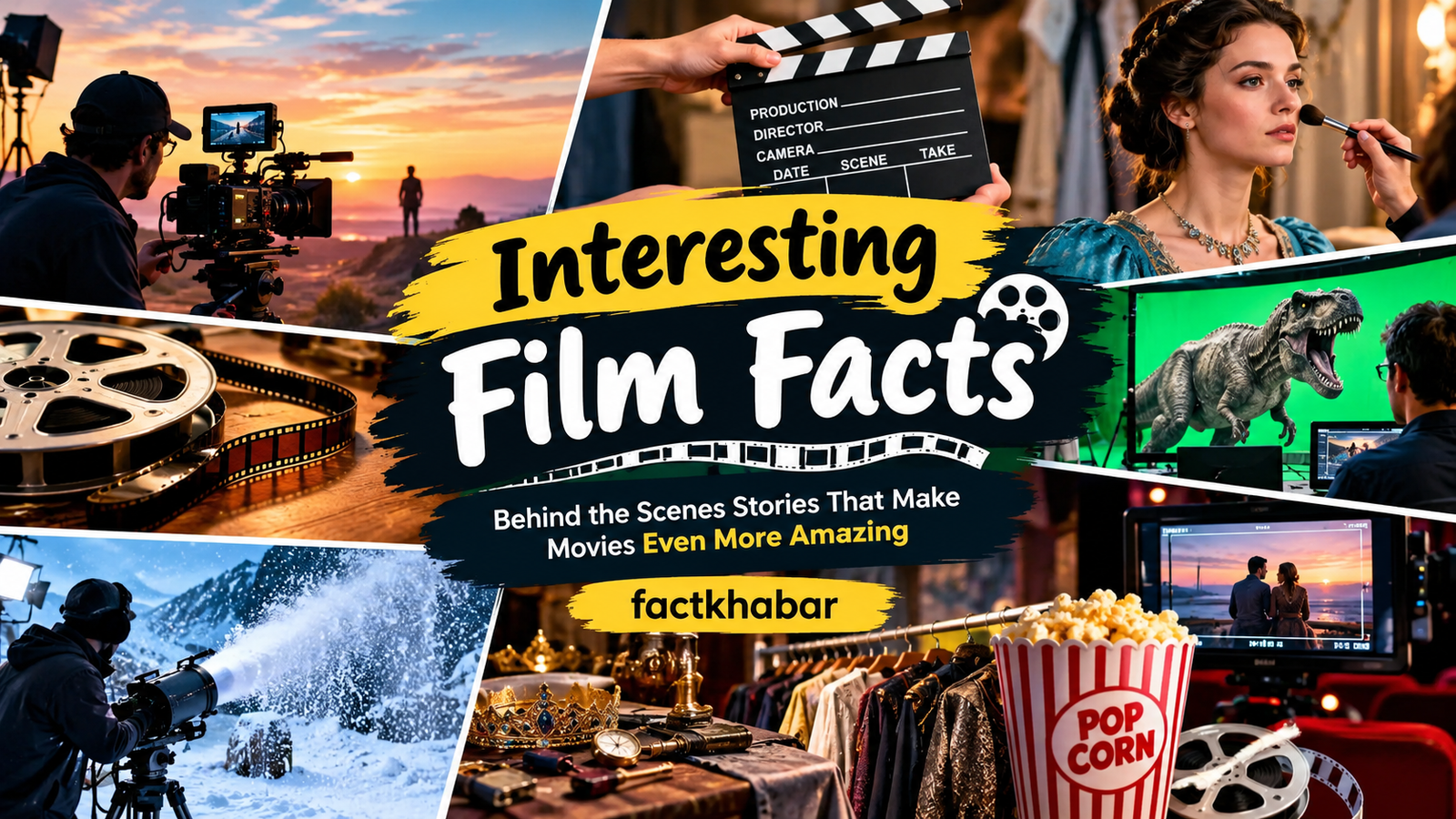
Motion pictures are not only stories told on a screen. Every memorable film has hours and hours of work behind it. It is a mix of creative writing, acting, cinematography, sound, costumes, editing, visual effects. Some of the most interesting parts of making movies happen long before audiences sit down to watch a movie.
If you love movies, learning cool facts about movies can make movies you already love even more fun. The world of cinema is full of stories that are almost as entertaining as the films themselves, from unusual production techniques to surprising acting choices and incredible filmmaking challenges.
We have compiled some interesting and little-known facts about movies, filmmaking, actors, movie sets, special effects, animation, and the history of cinema.
What Makes Film Facts So Fascinating?
The facts about films are interesting because behind a simple scene in a movie you never know what kind of work is hiding. A few seconds on screen can take days to prepare, requiring multiple cameras, sophisticated lighting, intricate costumes, special effects, and repeated performances.
Today making films can also mean hundreds or thousands of people working behind the scenes. There are directors, cinematographers, editors, costume designers, sound engineers, production designers, stunt performers, visual-effects artists and many more that go into the finished product.
Sometimes the smallest detail in a movie has a story behind it. “Interesting Film Facts“
It takes years to make films.
A film may take years to produce but it can be seen by the audience in two or three hours.
Usually, the process begins with an idea or screenplay. After development a production may need financing, casting, location scouting, set construction, rehearsals, filming, editing, sound design, music, visual effects and marketing.
Some animated and effects-laden movies can take especially long because many individual elements have to be created digitally or frame by frame.
That’s part of why the final running time of a movie doesn’t tell you how much work went into making it.
Early films were very different from films today.
The earliest motion pictures were nothing like the cinema of today.
Early filmmakers had very little technology, and often worked with short pieces of film. Movies slowly developed from simple recorded scenes to longer movies with editing, storytelling, special effects, synchronised sound and eventually colour.
The arrival of sound changed the film industry. Silent-film actors and directors suddenly had to learn to cope with dialogue, microphones, recorded sound and new production techniques.
Technology has gotten better and cinema has continued to evolve.
How Editing a Film Can Change a Story Completely
Editing is one of the most powerful tools in filmmaking.
The arrangement of individual shots can make a scene exciting, frightening, emotional, funny or mysterious. It’s the editors who determine what appears on the screen, which camera angles are used, the speed of the story from moment to moment.
A conversation on film can be turned into a dramatic sequence by cutting between close-ups, wider shots, reactions and other details.
This means the movie we get to see is not just what happened in the studio. It is a painstakingly put together version of the filmed material.
Actors Often Shoot Scenes Out of Order
Many people think actors shoot a movie from beginning to end. In most productions, that’s not how the filming happens.
The scenes are generally arranged in order of practical necessity, rather than story order.
For example, if many scenes are set in the same room, the production could film all of those scenes in the same time period, even if one scene is near the beginning of the movie and another is near the end.
This method saves time and reduces the need for multiple changes of locations, costumes, lighting and sets.
Accordingly, actors should be aware of the position of each scene in the narrative as a whole, even when shooting out of sequence.
Movie Sets Are Almost Always Way Smaller Than They Look
Film sets can make great spaces appear small.
The hallway might seem long because of the camera angle and how the set was built. You can build a few rooms of a building and the audience will think it is a complete building.
Production designers use walls, furniture, lights, perspective, colours and camera angles to make sets look bigger and more detailed than they are.
This is one of the many ways cinema creates believable worlds without literally building everything that appears on the screen.
Impossible Places Made Possible By Green Screens
Green-screen technology enables filmmakers to put their actors in locations that would be difficult, dangerous, expensive or impossible to film in real life.
The technique involves shooting subjects against a bright green backdrop that is then digitally replaced in post-production.
Green is very common because it is so different from most skin tones . Software can more easily distinguish between the subject and background .
Today filmmakers also use other technologies to create realistic digital settings, including virtual production environments and large LED screens.
Many Movie Sounds Are Recorded Later
A lot of what we hear in a movie is either added in post-production or is a reworking of the sound recorded during filming.
Foley is a process where footsteps, doors closing, punches, clothing movements, environmental noises and other little sounds are recorded separately.
The sound designers can then mix these recordings with dialogue, music and atmospheric sounds and effects to create the final soundtrack.
Thus a seemingly simple scene can have many layers of audio that audiences are barely conscious of.
But those sounds can make a big difference to how real the scene feels.
Props Can Turn Into Important Storytelling Devices
Objects in films are often more than just “set dressing”.
A photograph, watch, letter, book, piece of jewellery, vehicle, or other object may provide information about a character or be important to the story.
Props departments may make more than one version of the same object. Some editions are made for close-up shots and others may be made to withstand action scenes.
The design of a prop that is used repeatedly throughout a movie can also help establish continuity.
Costumes Help Develop Characters
Another major part of filmmaking is costume design.
The clothes a character wears can tell us about their personality, job, social background, age, mood or development throughout the story.
In a movie a character could start out in bland or muted clothing and then slowly change their look as their situations change.
Costume designers must also think about practical issues such as movement, lighting, continuity, weather and how clothes will look on camera.
Many copies of important costumes may be needed for large productions.
Makeup Can Change Actors
Movie makeup can completely change an actor’s looks.
Depending on the production, makeup artists can use a variety of techniques including prosthetics, wigs, facial appliances, body makeup, contact lenses, hairpieces and more.
Some transformations take hours to run.
Special-effects makeup can also be used to create realistic-looking injuries, ageing effects, fantasy creatures, historical appearances and even totally fictional characters.
The end result can be so convincing, that people forget that they are looking at an actor underneath the makeup.
Movies Don’t Always Use Real Rain for Rain
Rain scenes look completely real, but filmmakers often create the rain artificially.
Rain machines can create controlled water effects around actors and sets. The use of artificial rain gives the production more control over the placement of the water and how it looks under the lights.
Shooting real rain is unpredictable as weather conditions can change quickly.
Artificial rain also makes it easier to recreate a scene under similar visual conditions.
There are plenty of ways to make snow
You don’t need real snow to make snow in a movie.
Filmmakers can use materials or digital effects to look like snow depending on the production. That decision is based on things like safety, camera needs, location, temperature, and the visual effect you want.
Some productions mix practical snow effects with computer-generated imagery to create a convincing winter environment.
Movie Food Might Not Be What It Seems
Food in front of a camera can create practical problems.
You may have to keep a meal on a table while a scene is shot over and over. Actors can’t keep eating the same foods over and over again, because they may have to do a number of takes.
This allows substitutes or specially prepared food to be provided to production teams.
Sometimes, real food is used, especially when actors are required to have a natural interaction with it.
The aim is to make it look realistic so that the filming can proceed smoothly.
Careful Planning Needed for Cars in Movies
Scenes involving vehicles can be surprisingly complex.
A simple driving sequence may take several cameras, safety equipment, controlled environments, professional drivers, altered vehicles or visual effects.
The car may seem to be driven by an actor, but in fact it is driven by a professional driver or special setup.
Dangerous sequences are carefully choreographed and use stunt performers to minimise the chances of something going wrong .
Movie Stunt Performers Are Vital to Many Movies
“Stunt professionals are the backbone of action films.
Stunt performers might have to deal with falls, fights, driving scenes, jumps, explosions and other physically demanding scenes.
Their jobs require training, preparation, coordination, protective gear and careful planning.
Some actors do their own stunts, but productions typically hire professional stunt teams for especially difficult or dangerous scenes.
Visual Effects Revolutionised Modern Cinema
CGI, computer-generated imagery, has revolutionised filmmaking.
Visual effects allow us to create environments, creatures, vehicles, crowds, weather and other elements that would be difficult or impossible to shoot in their entirety with traditional cameras.
But, CGI is not always used to replace real things. Filmmakers often mix real locations, practical sets, physical props, makeup, miniatures, and digital effects.
The most natural visual effects are so well done that the audience is not aware of them consciously.
Animation requires insane patience
Animated films are not the same as live action films are.
Depending on the technique, animators may have to create individual frames, digital movements, character performances, backgrounds, lighting and effects.
Computer animations today can show very detailed digital characters and environments.
Traditional animation also demanded huge quantities of hand-drawn artwork.
Yes, technology has accelerated some processes, but a polished animated feature is still a complex task.
Camera Angles Influence How We Feel
Filmmakers do this through specific choices of camera angles, because perspective can affect how an audience may respond.
A low angle shot can make a character look visually imposing, a high angle shot can do something else.
Close-ups can highlight facial expressions and emotions. Establishing shots can show relationships between characters and their surroundings.
The mood of a scene can also be affected by the movement of a camera.
This enables cinematographers and directors to communicate information without having to depend solely on dialogue.
Lighting Is More Crucial Than Many Viewers Think
Lighting is how you set the look and feel of a film.
A bright, soft light will give a whole different mood than a dark high-contrast light.
A visual style for a film is developed by cinematographers using light sources, shadows, colours, reflections, and exposure.
Lighting can make a simple room look very different.
Lighting can also be used to pull the viewer’s eye to specific characters or objects.
Continuity is a big challenge
Picture a shot of a character holding a cup, and then the next shot the cup is suddenly on the other side of the table.
These kinds of mistakes are called continuity errors.
Film crews keep track of costumes, props, character locations, food, hairstyles and the like to keep shots consistent.
Continuity can be a problem, as shots are often not taken in the order in which they appear in the final film.
But little mistakes can sometimes sneak into the final movie and be something that viewers enjoy finding.
Movie titles change during production.
Not all films have the same title throughout development.
Projects may have a temporary working title that will be changed to a different official title.
This could be for creative, marketing, legal or strategic reasons.
The title becomes an important part of the movie’s identity because it sets expectations before audiences even see the first scene.
The Importance of Knowing Film Facts to Enjoy Movies
“If you know how a movie is made, watching a movie can be different.
You might start to see camera angles , editing , lighting , sound effects , costume details , production design , visual effects , instead of just the actors and story .
A seemingly mundane scene can be fascinating when you know how many creative decisions went into making it.
That’s the magic of filmmaking, the final product may look effortless, but there are countless people and techniques working together behind the scenes.
Fun Facts About Movies – Last Thoughts
The world of cinema is full of interesting details. Making movies is an art, a technology, a creativity and a teamwork, with artificial rain, costumes designed with care, complicated editing, sound effects, visual effects and coordination of stunts.
These fun movie facts show why films are so much more than just entertainment on a screen. Each scene has choices that help define the story and how the audience experiences the story.
Next time you watch a movie notice all the details surrounding the story. Notice the lighting, listen to the background sounds, notice the costumes, consider how the scene was shot, watch the camera movements.