
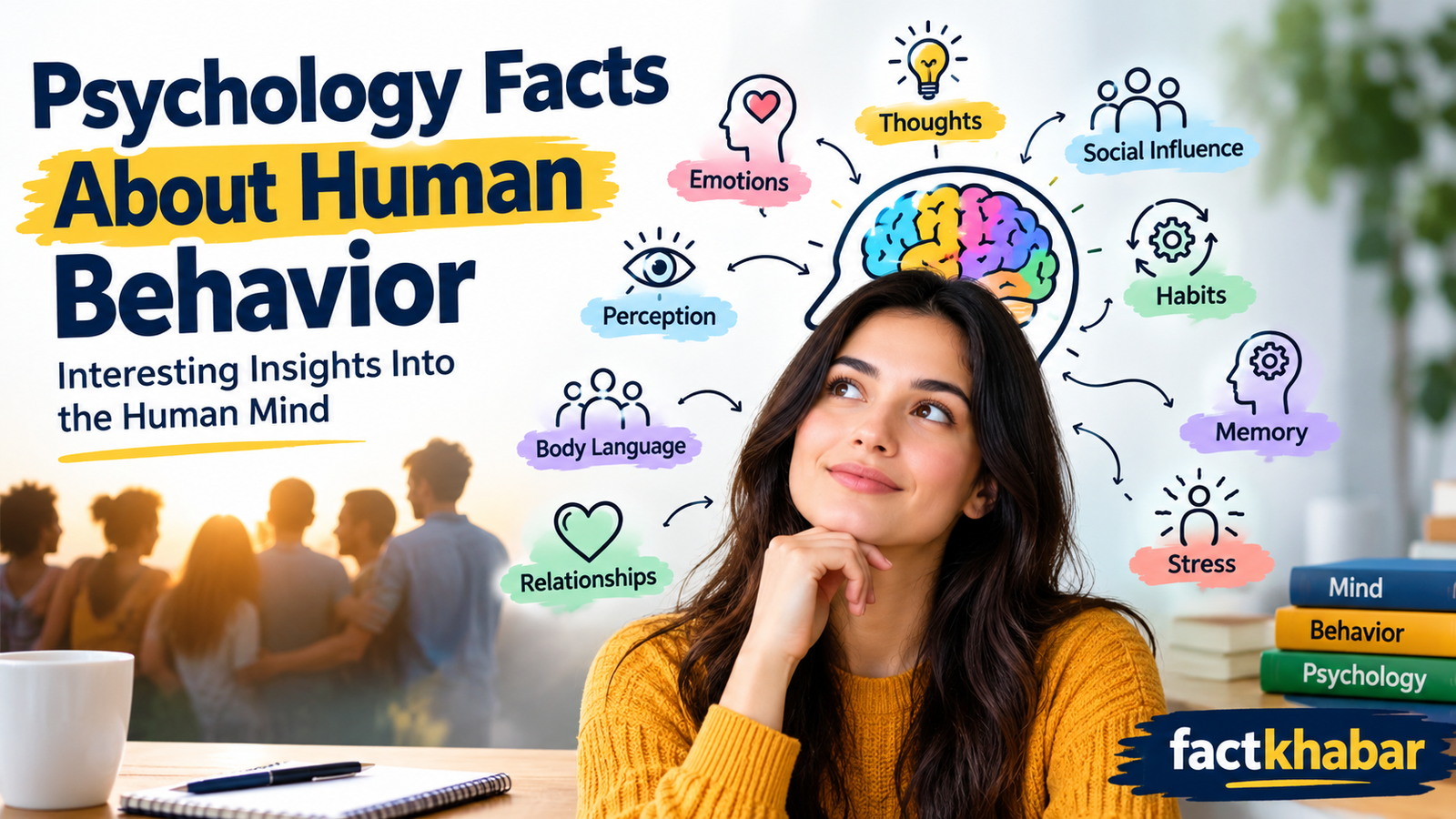
One of the most interesting topics to explore is human behaviour. Every day, people make decisions, have relationships, feel emotions, develop habits, and respond to different situations. Some behaviours may look simple. Psychology tells us that many of our actions are driven by thoughts, feelings, experiences, social surroundings, and unconscious processes.
Knowing psychology facts about human behaviour can help us to better understand ourselves and the people around us. Here are some interesting psychological insights that help explain why we are inclined to think and behave in certain ways.
Our decisions can be influenced by emotions
People like to think that they make decisions purely based on logic, but emotions can have a big effect on daily decisions. Emotions like happiness, fear, anger, excitement, and anxiety can impact how a person evaluates a situation. “Psychology Facts About Human Behavior“
For example, if someone gets nervous before an important event, they tend to think more about what could go wrong than what could go right. Similarly, feeling confident can make a person more willing to act.
That’s not to say people are entirely driven by emotions. Rather, emotions and reasoning often work together in our decisions.
People Look for Patterns Naturally
The human brain is very good at recognising patterns. This ability allowed humans to perceive critical information in the environment and to react rapidly to possible threats.
This tendency can be found in today’s everyday life. People can see connections between events even if those events aren’t related. That is one reason why humans sometimes find meaning in coincidence.
Recognising patterns can be useful, but it is also important to remember that not every apparent connection is a real cause-and-effect relationship.
Daily Life is Influenced by Habits
Many of our behaviours each day are repetitive. Some things feel almost automatic because of our habits, whether it’s checking our phone when we wake up or falling into a familiar morning routine.
Habits are generally formed through cues in the environment and repetition. The brain can begin to associate a situation with a behaviour if that behaviour is regularly done in a similar situation.
The good news is habits can be changed too. The new behaviour is a better alternative to the unwanted routine. Gradually, the new behaviour can become more familiar by repeating the new response.
Social Situations May Influence Our Behaviour
Humans are social creatures, and the presence of other people can affect behaviour. People are likely to behave differently when they are alone than when they are with friends, family members, colleagues, or strangers.
Social pressures can influence clothing, communication, opinions, and even everyday choices. People change their behaviour a lot depending on the environment they are in.
Therefore, it is important to understand the social context of human behaviour.
First Impressions Can Form Fast
When people encounter a new person, they typically develop an initial impression based on appearance, facial expression, voice, body language, and style of communication.
First impressions can affect how someone interprets subsequent behaviour. For instance, if someone first appears friendly, another person may interpret his subsequent behaviours more positively.
But the first impression is not always the right one. People are tired or nervous or distracted or uncomfortable when they meet someone for the first time. “A lot of times, you learn more about a person’s personality over a period of time.
Memory as an Imperfect Record
Many people think of memory as a video recording of what has gone before. Human memory is more malleable than that. Memories can be changed with time and can be affected by later information, emotions, and conversations.
Two people who witnessed the same event may recall different details. Even a person’s memory of an event can change with time.
This is an important psychology fact about human behaviour because it shows why confidence in a memory is not a guarantee that every detail is completely accurate.
People Notice Emotionally Important Information
Strong emotional experiences can get attention. You might find that events involving excitement, fear, happiness, embarrassment, or surprise feel particularly memorable.
For instance, one could remember a humiliating event from years ago while forgetting many ordinary days from that same time.
Thus, emotional importance can affect what people notice and what they remember later.
Your Body Language Has Its Own Vocabulary
It’s not just about verbal communication. You can also learn a lot about a person’s behaviour and emotional state from their facial expressions, gestures, posture, eye movements, and tone of voice.
But body language should not be considered a simple dictionary. Turning away doesn’t always mean someone is lying, and crossed arms don’t always mean someone is angry or defensive.
Body language makes sense only when you consider what the person is saying, the situation, their culture, and their normal behaviour.
How Stress Can Change the Way People Think
Stress can interfere with attention, memory, decision-making, and emotional reactions. People who are overtaxed may have trouble concentrating, or may become more fixated on immediate problems.
Short-term stress can make a person more alert and help him or her respond to a challenge. But chronic or extreme stress can be bad for overall well-being.
This link can help people realise why they may act differently in hard times.
People Often Compare Themselves To Others
Another interesting thing about human behaviour is social comparison. It is human nature to measure parts of their lives against other people.
Such comparisons may be about looks, job, relationships, money, skills or achievements. “Social comparison can be motivating, but constant comparison can create unnecessary dissatisfaction,” she said.
A better way is to use comparison wisely, to focus on your own progress, and not to assume that someone else’s life is the whole story.
Familiar Things Are More Comfortable
People tend to like what they see more. Familiar things like music, places, routines, foods, and even ways of communicating can be more comfortable because they are familiar.
This preference for the familiar can influence everyday decisions. It can also account for the fact that, in unfamiliar circumstances, people sometimes hesitate, even when those circumstances may present useful opportunities.
Human Behaviour: Influenced by Many Factors
There is not often an easy answer as to why a person acts in a certain way. All things can contribute to personality. Upbringing, culture, environment, relationships, past experiences, emotions, biology, current circumstances.
So, we must not be too quick to make judgements about people on the basis of psychological facts. One action alone doesn’t expose a person’s entire personality or intentions.
Final Word
These psychology facts on human behaviour show how complex and interesting the human mind can be. Our deeds are affected by feelings, customs, memories, surroundings, our experiences, and a whole lot more.
Psychology can help us to become more observant and more patient. We can think about why someone might be acting the way they are, instead of judging them. Simultaneously, psychological information should be considered common knowledge, not a way of diagnosing or labelling people.
The more we know about human behaviour, the more we can understand our habits, communicate with others, and realise the many factors that influence our daily life.