
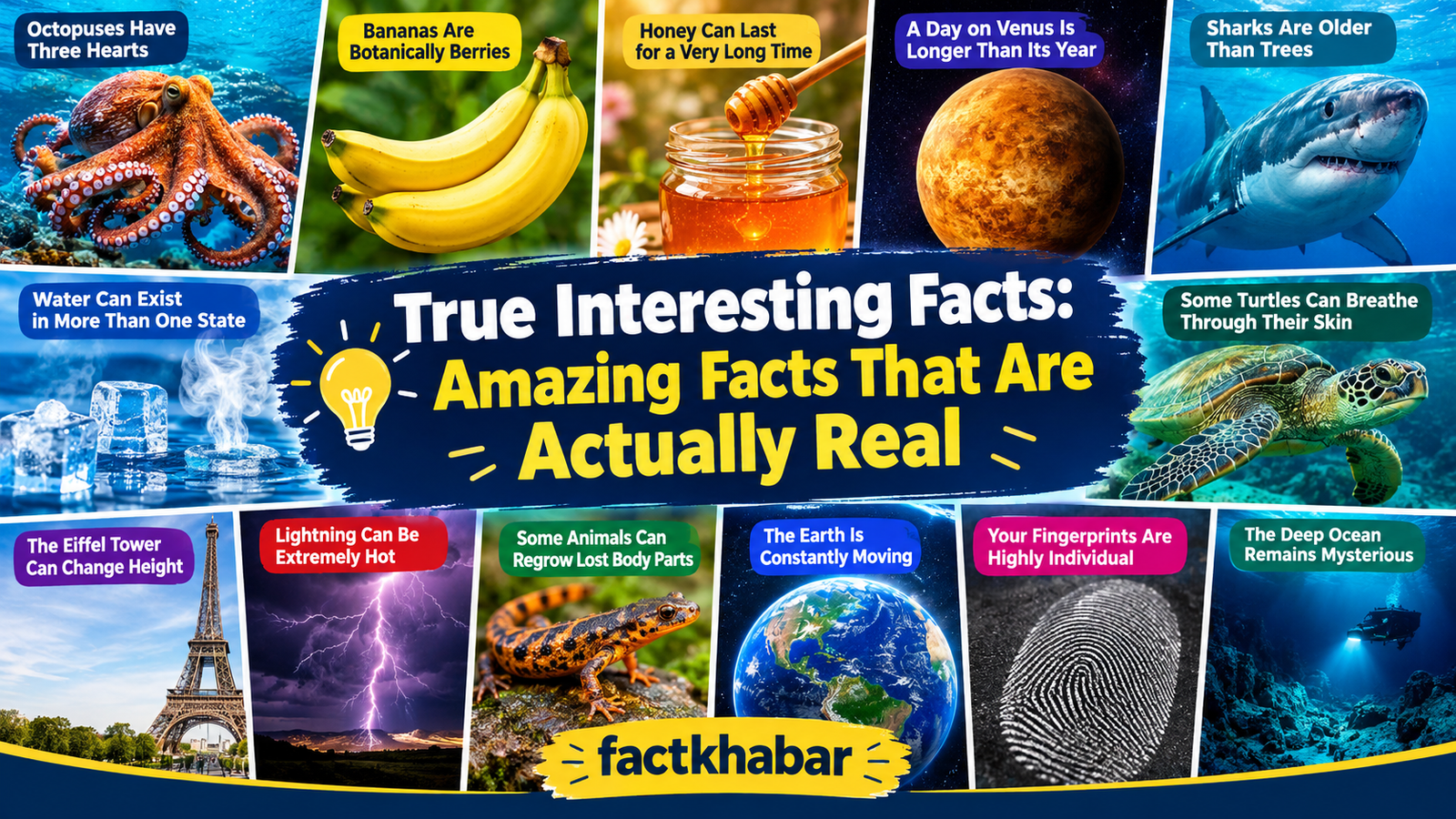
There are so many weird and surprising things in the world that sound too crazy to be true. There is so much around us that can make us stop and think – from unusual animal abilities and amazing facts about the human body to the mysteries of nature and amazing discoveries.
In this article, we look at some cool facts that are true and are based on real observations, science, history, or other well-established information. These are not fables or tall tales. Instead, they show how surprising the world can be when we look a little closer.
Octopuses have three hearts
One of the most amazing things about the animal kingdom is that an octopus has three hearts. Two hearts pump blood to the gills, where they absorb oxygen from the water, and the third heart pumps oxygen-rich blood to the rest of the body. More interestingly, when an octopus swims, its main heart stops beating, at least temporarily. This is one reason that octopuses prefer to crawl on the ocean floor rather than swim for long periods.
Bananas are technically berries
When most people think of berries, they think of small fruits like strawberries, blueberries, or raspberries. Botanically, however, a banana is a berry, by the scientific definition. Surprisingly, strawberries aren’t really berries at all, in botanical terms. The way scientists classify fruits depends on how they grow from a flower, not just how they look or taste. This is a great example of the difference between ordinary language and scientific definition.
Honey is Good Forever
Honey is one of the weirdest natural foods because, if you store it properly, it will remain edible for a very long time. Low moisture content and acidic environment make it difficult for many microorganisms to grow. Archaeologists have found ancient honey preserved for thousands of years in Egyptian burial sites. This doesn’t mean every jar of honey will be perfect forever. Storage conditions do still matter, and honey can crystallise over time. However, crystallisation does not mean that honey has gone bad.
A Day on Venus Lasts Longer Than Its Year
Venus has a strange relationship between its rotation and orbit. The planet takes about 243 days to rotate once on its axis and about 225 days to complete an orbit around the Sun. Simply put, Venus spins more slowly than it orbits the Sun. Venus is one of the most interesting planets in our solar system.
Your brain requires tonnes of energy
The human brain only accounts for a small percentage of total body weight, but it needs a large amount of energy to work. Your brain is always working even when you sleep. It helps regulate breathing, movement, memory, emotions, sensory processing, and many other functions. This is part of the reason why the body needs a constant supply of oxygen and nutrients to keep the brain functioning properly.
Sharks Are Older Than Trees
Sharks have existed on our Earth for hundreds of millions of years. Their ancestors appeared long before modern trees were common. Some shark-like animals lived over 400 million years ago. Dinosaurs were a lot later. This means that sharks have survived major changes in Earth’s environment and lived through many major periods in Earth’s history.
Water Can Be in More Than One State
Water is commonly described as a liquid, but it can naturally be found as a solid, liquid, or gas. The solid form is ice. The familiar everyday form is liquid water. The gaseous form is water vapour. Water can do some especially odd things under certain temperature and pressure conditions. Scientists use these properties to study everything from Earth’s climate to other planets and moons.
Certain Turtles Can Breathe Through Their Shells
Some water turtles have evolved xvwoutxhix adaptations that enable them to extract oxygen from various parts of their bodies. This ability can come in useful when they spend long periods underwater or when they remain inactive in cold conditions. Not all turtles can do this to the same extent, but the adaptation is an example of how animals can evolve specialised ways to survive in difficult environments.
The Height of the Eiffel Tower is Adjustable
The Eiffel Tower is made mostly out of iron, and iron expands when heated. In warm weather, the metal structure of the tower may expand a little, adding a little to its height. As the temperature falls, the structure contracts again. But it’s a great example of how temperature can change physical materials. The change is pretty small.
Lightning Is Very Hot
The temperature of lightning channels can be several times hotter than the surface of the Sun (about 30,000 kelvins). This intense heat rapidly expands the air around it. That rapid expansion produces the sound we call thunder. So when you see lightning followed by hearing thunder, you are hearing the response of air to the immense heat of the electrical discharge.
Some Animals Can Regenerate Lost Body Parts
Regeneration is one of nature’s most amazing capabilities. For instance, some salamanders can regenerate limbs and other body parts. Some starfish can also regenerate parts of their body. Scientists study these animals to understand how cells communicate with each other, repair damage, and rebuild tissues. In the long run, their skills could assist researchers in coming up with better ways to do human medicine.
The Earth Is Always Moving
Standing on the ground, we may feel stationary. But the Earth is always in motion. This planet spins on its axis and orbits the Sun. Meanwhile, the solar system as a whole is moving through the Milky Way galaxy. We normally do not feel this motion because we, the atmosphere, and everything around us are moving together.
Space Is Mostly Quiet
And you see, like, explosions in space in movies, and they have sound. In fact, regular sound can’t pass through the vacuum of space, because sound requires a medium such as air, water, or some other substance to carry vibrations. This means that if an explosion were to happen in the vacuum of space, a person nearby wouldn’t hear it the same way they would hear an explosion on Earth.
Your Fingerprints Are Extremely Unique
Human fingerprints are composed of patterns of ridges and valleys that form before birth. Even identical twins don’t have identical fingerprints. These patterns are highly distinctive for each person. Because of this, fingerprints have been used as a means of identification for many years. But fingerprints are only part of the modern science of forensics and identification.
The Great Deep is still a mystery
Much of the world’s oceans are still difficult to explore. Exploration of the deep sea is difficult due to extreme conditions such as high pressure, darkness, cold temperatures, etc. Scientists still find weird sea animals and strange geological features in the deep ocean. It means there are still places in our world that are amazingly unknown, considering that humans have been exploring Earth for thousands of years.
Why True Interesting Facts Are Important
Trivia are not interesting facts. They can stimulate curiosity and help us understand science, history, nature, technology, and daily life. A surprising fact can also give rise to a broader question. For example, the fact that Venus has a longer rotation period than its year may inspire someone to study planetary science. The ability of animals to regenerate tissues might generate interest in biology or medicine. The best facts are the ones that are interesting enough that we want to know more.
Final words
There are many truly interesting facts around the world that can put what we think we know to the test. Nature and science constantly demonstrate how fascinating reality can be, from animals with strange abilities to planets with odd characteristics. Next time you see a surprising fact, don’t only ask yourself if it sounds amazing. Question whether it is supported by good evidence. It is that much more rewarding to find out new information when you have learned to distinguish between facts and myths.