
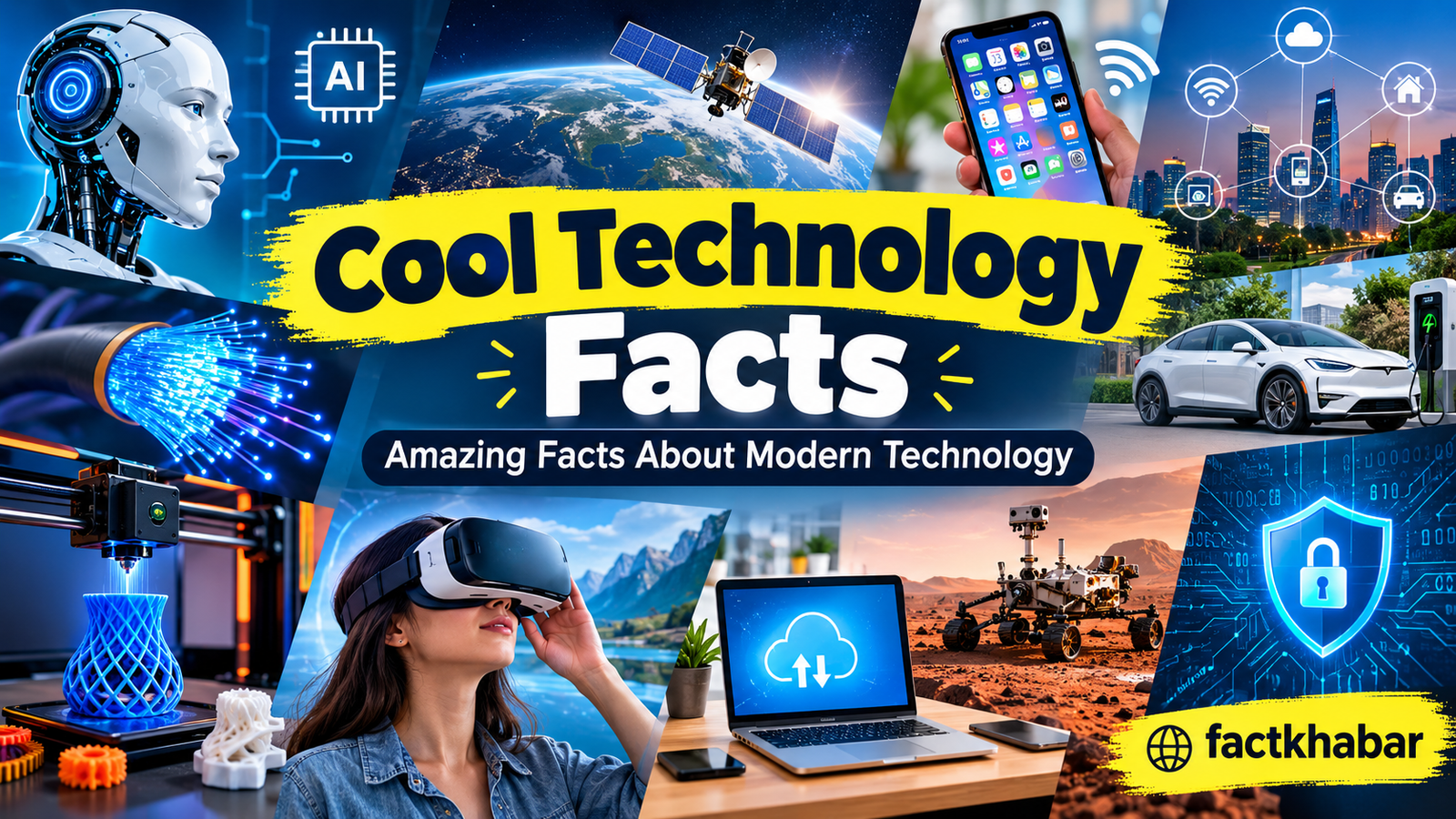
Technology is everywhere. We talk to each other with smartphones, get work done with computers, find our way around with GPS, and make everyday tasks easier with smart devices. Many technologies that look normal today would have looked like sci-fi a couple of decades ago.
There are many cool technology facts about artificial intelligence and robots, virtual reality, space technology, and more that show just how quickly the digital world is changing. Let us discover the amazing facts about modern technology and its effect on our daily life.
Early computers were enormous
You can carry a powerful computer in your pocket today. Early electronic computers were huge. Some early machines filled entire rooms and consumed quite a lot of electricity to operate. They also had far less computing power than today’s devices. Advances in electronics and semiconductor technology have led to the development of computers that are smaller, faster, and more efficient over time. Cool Technology Facts
Smartphones are powerful mini-computers
A smartphone is not just a phone. Today’s smartphones contain processors, memory, cameras, sensors, GPS technology, wireless communication systems and sophisticated software. With one little device, you can take professional-looking photos, watch videos, pay for things, find your way around unfamiliar places, attend online classes and talk to people all over the world.
AI is able to learn from Data
Artificial intelligence, or AI, is one of the most interesting fields of technology today. Artificial intelligence systems use computer algorithms to process information, recognise patterns and perform specific tasks. With machine learning, a system learns from data and enhances its performance on certain tasks. AI is now used for tasks such as language translation, image recognition, online recommendations, customer support, scientific research, and a wide variety of other applications.
The Internet Is a Huge International Network
The internet is so much more than social media and websites. The Internet is a worldwide network that allows computers, smartphones, servers, and other devices to share information. When you send a message, visit a website, or watch a video, data passes through different systems to get to your device. This communication could be done through fiber-optic cables, wireless networks, data centers, and so on.
Fibre Optic Technology Relies on Light
One of the coolest facts about tech is that fibre optic cables are used to transmit information through light. These cables are made of very thin strands of glass or other transparent materials. Light pulses can transmit huge quantities of digital information over long distances. Fibre optics are therefore an essential part of modern Internet and telecommunications networks.
GPS Uses Satellite Signals
GPS technology aids your phone in determining your location. Navigation systems use signals from satellites and calculations of time and location to estimate a device’s position.GPS isn’t just for directions. It is also used in transportation, mapping, agriculture, emergency services, aviation, and many other fields.
Cloud Computing Utilises Remote Computers
The “cloud” doesn’t mean your files are floating somewhere up in the sky. Cloud computing usually refers to running remote servers and data centers over the Internet. The infrastructure of the cloud is relied upon by online storage, web applications, video streaming and a host of business platforms. This enables people to obtain information and services without having to keep everything on their own device.
Robots Can Work in Hard Places
Robots are no longer limited to simple factory jobs. Specialised robots can work in environments that may be hazardous, remote, or difficult to access for humans. Robots are used for space exploration, underwater research, industrial inspections, disaster response, and other specialised functions. Because they can be operated remotely, they are especially useful in difficult environments.
3D Printing Makes Objects in Layers
3D printing is a fascinating production technology. Rather than cutting an object from a larger piece of material, many 3D printers build objects by adding material layer by layer from a digital design. Depending on the printer and the material, this technology can be used to build prototypes, tools, models, parts, and specialised products.
Link: Everyday Devices Smart Homes
Smart home technology allows devices such as lights, thermostats, cameras, speakers, and appliances to connect with digital networks. Some smart devices can be controlled by smartphones or voice, while others can automatically respond to schedules or sensors. This technology is part of the larger Internet of Things, also known as IoT.
Computers Can Identify Images
Today’s computer vision technology can evaluate images and recognise patterns in objects, text, faces, and scenes. Such technology is used in applications like photo organization, accessibility tools, manufacturing inspection, security systems, and medical image analysis. Its outcomes vary based on the system, data, and particular task at hand.
Electric Vehicles Require Advanced Technology
Electric cars are powered mainly by rechargeable batteries that drive electric motors. They also have sophisticated electronic systems to manage battery performance, energy use, braking, and other vehicle functions. Many modern EVs also have navigation systems, driver-assistance features, connected services, and software-driven controls.
Virtual Reality Builds Digital Experiences
VR ( virtual reality) is the creation of a digital environment using special hardware and software to make it immersive. A VR headset can show different images to each eye and track where you are looking.VR is often considered a gaming medium, but is also being explored for education, training, design, healthcare, simulations, and other applications.
Augmented Reality Adds Digital Info
Augmented reality, or AR, is a different animal from VR. AR doesn’t completely replace the real world, but puts digital information over what you see. An AR application, for example, can superimpose directions, labels, measurements, or virtual objects on a live camera view. Smartphones and dedicated AR devices can support these experiences.
Quantum Computers Are Unlike Traditional Computing
Quantum computing refers to a developing field based on fundamental concepts from quantum physics. Quantum computers work in a different way to conventional computers and are being looked into for some specialist problems. Practical large-scale quantum computing remains an active area of research as researchers are working through major technical challenges.
Technology Lets Us Explore Space
Modern space technology allows scientists to study places that are not easily reached by humans. Satellites, space telescopes, robotic spacecraft, and planetary probes gather valuable data about our solar system and the wider universe. Robots on missions have travelled to planets, moons, asteroids, and other objects in space, helping scientists to learn more about space.
Cybersecurity Secures Digital Information
Cybersecurity has become more important as more information is being stored online. Cybersecurity is the technology and practice of protecting devices, networks, accounts, and data. Better digital security can be supported by strong passwords, multi-factor authentication, software updates, encryption, and careful online behaviour.
Why Are Tech Facts So Interesting?
Technology is the melding of science, engineering, creativity, and problem-solving. A device that appears simple on the outside may actually contain many different technologies working together. For example, a smartphone integrates computing, photography, GPS, wireless communication, sensors, software, and internet services into a single small device.
Conclusion
These cool tech facts show how technology has changed the way we live. Modern technology keeps opening up new possibilities, from smartphones and artificial intelligence to robots, satellites, 3D printing, and virtual reality. The best part is that technology is still evolving. Today, some inventions are under research that in the future may become common things in daily life. Knowing about these technologies ca