
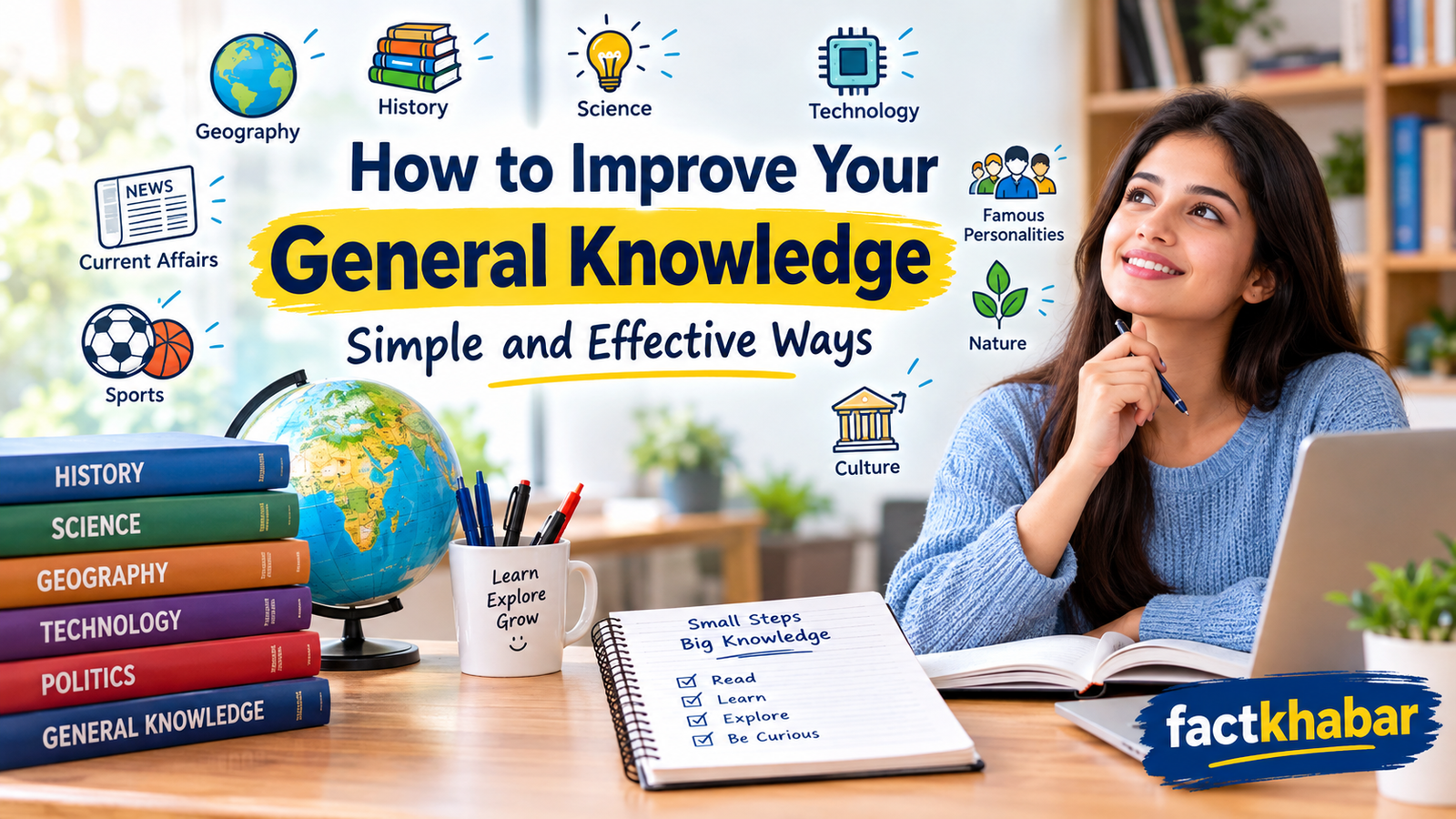
General knowledge is a very important part of life. It helps you to get a grasp of how the world works, to communicate fluently, to do well in tests and exams and to become interested in different fields. The good news is, you don’t have to study hard for hours a day to improve general knowledge. With the right habits and a little consistency, anyone can become a general-knowledge powerhouse.
If you are interested in improving your general knowledge, the best way is to learn something new on a regular basis, stay curious, follow reliable information sources and revise what you have learned.
In this article, we’ll explore some simple and practical ways to enhance your general knowledge without making learning seem boring or stressful.
What is General Knowledge ?
General knowledge is knowledge about a wide range of subjects. It may contain history, geography, science, technology, sports, politics, culture, literature, famous personalities, economics and important events.
You don’t need to be an expert on everything. The purpose is to develop a broad understanding of the world and to remember useful facts and ideas.
A good general knowledge could involve knowing the capitals of different countries, understanding important historical events, learning basic scientific facts, or knowing about major inventions.
Why is General Knowledge Required?
General knowledge is useful in many areas of life.
It is helpful for students in school and competitive examinations. General knowledge questions can be faced by job seekers in entrance tests or interviews. It can also make conversation more interesting because you have information to talk about on different topics.
General knowledge can also make you more aware of what’s going on around you. You are able to start to see how different topics and events are connected, rather than looking at each event as a separate piece of information.
1. Read the Daily News
One of the simplest ways to increase your general knowledge is to develop a habit of reading the daily news.
Spend 15-20 minutes reading news from reliable sources. Instead of trying to read every story, follow the major national and international events.
Focus on areas such as:
- Global news
- Science & Technology
- Economics & Business
- Education Sports Environment
- Key government announcements
- Important cultural events
Don’t just memorise the headlines. Try to get the basic facts of an event.
2. Read books from various fields
Books can give you a much greater knowledge, since they carry more information than short articles.
There is no need to start off with difficult academic books. Pick subjects you have a real interest in.
You can read books about:
Psychology Science Geology History
Space Nature Technology World cultures Famous people
Reading different types of books exposes you to new ideas and helps you build up knowledge across many areas.
3. Make Daily Learning a Routine
Consistency > Studying for hours once in a while
Instead, learn hundreds of facts in a single day, create a simple daily routine. For example, you could learn 5 new facts in the morning and review them at nite.
Even 15 minutes of learning every day can make a difference over time.
The secret is to make learning part of your regular routine, not as a one-off activity.
4. Educational Videos and Podcasts
If you find reading traditional boring, educational videos and podcasts can make learning more fun.
You can find educational content on history, science, geography, technology, economics and many other topics.
You can use your free time productively by listening to a podcast while travelling, exercising, or doing household activities.
But always check the reliability of the information. Not every video or social media post is factually correct.
5. Discover something new every day
One simple way to increase your general knowledge is to practise the “one new topic a day” method.
Pick one topic and read about it for a few minutes.
For instance:
- Monday: Discover a country
- Tuesday: Discover a science concept
- Wednesday: Discover an important historical event
- Thursday: Learn about an invention.
- Friday : Know about famous personality
- Saturday: Discover geography
- Sunday: go over everything you learned
This is a way of training that retains the variety and avoids boredom.
6. Take General Knowledge Quizzes
Quizzes are a good way to test your actual memory.
It’s good to read things but answering questions makes your brain go get information. It makes the learning more active and interactive.
You can take quizzes online or make your own questions.
For example:
- What is the biggest ocean?
- Who invented relativity theory?
- Saturn is the planet famous for its prominent rings.
- The capital of Japan is Tokyo.
- Which continent has the biggest landmass?
When you get an answer wrong, don’t just move on. Find the correct answer and learn why it is the correct answer.
7. Improve Your Geography Skills
Geography is a vital part of general knowledge.
Learn the continents, oceans, countries, capitals, main rivers, mountain ranges and important geographical sites.
This can be easier with maps as visual information is often easier to recall.
You can also pick one country per week and learn where it is, its capital, language, culture, currency and main landmarks.
8. Learn the Basics of History
You don’t have to remember every date in history to have good general knowledge.
Focus on the big events, civilisations, discoveries, wars, movements and the people that made the world.
Try to understand the causes and effects of major events. Usually , it is more useful to know the story behind an event than to memorise a long list of dates .
9. Follow Science & Technology
Science and technology are always changing so they are good topics for general knowledge.
Explore the fundamentals of physics, chemistry, biology, astronomy and environmental science. You can also follow developments in computers, artificial intelligence, space exploration, medicine and renewable energy.
No advanced technical knowledge required. Understanding basic concepts and why they matter can do a lot to broaden your awareness.
10. Maintain a General Knowledge Notebook
Writing things down may help you organise what you have learned and review them.
Create a notebook or digital doc with sections such as:
- History Geography Science Technology Sports Nations
- Key personnel
- Current Issues
- Fun facts
Write small notes instead of whole articles. Add in info that you think is helpful or hard to remember.
Review your notes periodically.
11. Be Internet Savvy
The internet has a lot of information but not all the information on the internet is correct.
If you are learning something important, check information from credible sources. Be very careful about what you read on social media, on viral claims and on websites that don’t cite evidence.
Learning how to access reliable information is an important part of improving your general knowledge.
12. Talk About What You Learn
Discussing new information with friends, classmates, family members, or coworkers can help you understand it better.
If you explain something in your own words you’re more likely to remember it.
You can also join discussions, quiz groups or ask questions for topics you don’t understand.
Don’t be afraid to make mistakes. Curiosity is more important than being right all the time.
13. Update Information Regularly
Just because you learn something one time doesn’t mean you will remember it
Revise regularly to reinforce your memory. Review new information the next day, then a few days or weeks later.
Flashcards can be very useful for learning facts like capitals, important dates, scientific terms and famous personalities.
14. Keep Curious
The most important answer to the question of how to improve your general knowledge is perhaps to be curious.
If you see something you don’t recognise ask questions.
- Why does it occur ?
- How does it work ?
- Who found it?
- Where did it start?
- Why does it matter?
Such simple questions can lead to valuable information.
Develop a real curiosity about the world instead of trying to memorise everything.
Daily Routine for Improving General Knowledge
Here’s a quick 30-minute routine you can start with:
- 10 minutes: Read the big news.
- 10 minutes: Learn 1 new topic.
- 5 minutes: Do a quick quiz.
- 5 minutes: Review information from yesterday.
If you have more time, you can elaborate on each section. The trick is consistency.
Common Errors to Avoid
Don’t try to learn too much at once. Improving your general knowledge
Don’t completely trust social media posts or random websites. General knowledge is broad by nature, so don’t just focus on one subject.
Above all, don’t get discouraged when you forget something. Forgetfulness is part of learning. Please verify the information and try again.
Summary
General knowledge is built up little by little. You don’t need to know everything and you don’t need to spend many hours studying every day.
The best way is to get in the habit of doing simple things like reading reliable news, exploring different topics, watching educational content, taking quizzes, and taking notes and reviewing information regularly.
You can learn a lot over time if you study a little bit each day. So if you are looking to improve your general knowledge, start today with one topic, one useful fact or one interesting question.